Thickness Gauge
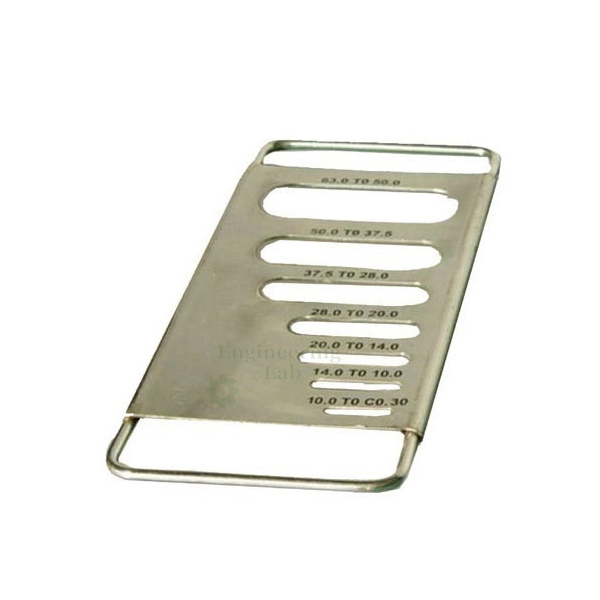
Product Code : EL-ATLE-10474
Thickness Gauge (code EL-ATLE-10474) is a slotted gauge used to decide whether aggregate particles count as flaky, that is, thinner than 0.6 of their nominal size. Aggregate is first separated into seven sieve fractions from 6.3 to 63 mm, and each fraction is tried in its own slot, from 4.9 × 30 mm up to 33.9 × 100 mm; the gauge measures 310 × 130 × 10 mm and weighs approximately 0.4 kg.
Get a quote: use the Add To Cart enquiry button below, or send your quantity and delivery location through the contact page.
Specifications
| Parameter | Detail |
|---|---|
| Use | Determining whether aggregate particles are flaky, i.e. thickness less than 0.6 of their nominal size |
| Sieve fractions | Seven, from 6.3 to 63 mm, each examined separately |
| Slot sizes | 4.9 × 30 mm, 7.2 × 40 mm, 10.2 × 50 mm, 14.4 × 60 mm, 19.7 × 80 mm, 26.3 × 90 mm, 33.9 × 100 mm |
| Dimensions | 310 × 130 × 10 mm |
| Weight | Approx. 0.4 kg |
| Standards | BS 812-105.1 |
| Product code | EL-ATLE-10474 |
| Manufacturer | Engineering Lab Equipment, Ambala, Haryana, India |
What Is the Thickness Gauge Used For?
Flaky particles are thin in relation to their other dimensions; in large numbers they make concrete harder to work and compact and can break up under load in road layers, so their proportion in an aggregate is kept in check. After sieving, the operator takes each of the seven fractions in turn and tries every particle in the matching slot of the gauge, and the particles that pass through are the flaky ones. These are weighed together, and their mass as a percentage of the total sample gives the flakiness index. The standard listed for it is BS 812-105.1.
What to Specify When Ordering
- Quantity — the number of gauges required.
Frequently Asked Questions
When is an aggregate particle classed as flaky?
A particle is treated as flaky when its thickness is less than 0.6 of its nominal size, which the gauge checks by passing the particle through a slot of set width.
What slot sizes does the Thickness Gauge have?
Seven slots are provided: 4.9 × 30 mm, 7.2 × 40 mm, 10.2 × 50 mm, 14.4 × 60 mm, 19.7 × 80 mm, 26.3 × 90 mm and 33.9 × 100 mm.
How is the sample prepared before gauging?
The aggregate is separated by sieving into seven fractions between 6.3 and 63 mm, and each fraction is then examined separately in its corresponding slot.
How big and heavy is the gauge?
The gauge measures 310 × 130 × 10 mm overall and has an approximate weight of 0.4 kg.
Which standard is listed for the gauge?
The standard listed for it is BS 812-105.1, the method for determining the flakiness index of coarse aggregate.
OEM Manufacturer
Engineering Lab Equipment (Engineering Labs Equipment Pvt Ltd) builds the Thickness Gauge at its works in Saha, District Ambala, Haryana (Plot No. 43, Industrial Park, Sector 2, Growth Center). Its aggregate testing equipment for grading, strength, abrasion and shape tests go to engineering colleges, polytechnics, technical training institutes and research laboratories in India and abroad, and equipment can be made to an institution's own requirements. For tenders and OEM supply, see the Tenders/OEM page.
Related Aggregate Testing Equipment
- Flakiness Sieve Set — set of 7 slotted steel sieves for flakiness index testing of 6.3 to 63 mm aggregate.
- Shape Index Caliper — 200 mm aggregate shape caliper graduated in 0.05 mm, measuring 450 × 150 × 50 mm.
- Length Gauge Elongation Gauge — hard wood based elongation gauge with vertical metal studs for checking aggregate particle length.
- Average Least Dimension — measuring box with adjustable 2-9 mm spacer and 10-18 mm extension for the ALD of fine aggregates.
See the full Aggregate Testing Lab Equipment range or all Civil Engineering Lab Equipment.
Request a Quote
For this and other aggregate testing lab equipment, schools and colleges can contact Engineering Lab Equipment, a manufacturer, supplier and exporter based in Ambala, India. For a price, send the number of thickness gauges required and the delivery location through the contact page; the Add To Cart button on this page also adds the Thickness Gauge to an enquiry.
Last updated: October 2026