Relative Density Test Apparatus
Product Code : EL-STLE-10376
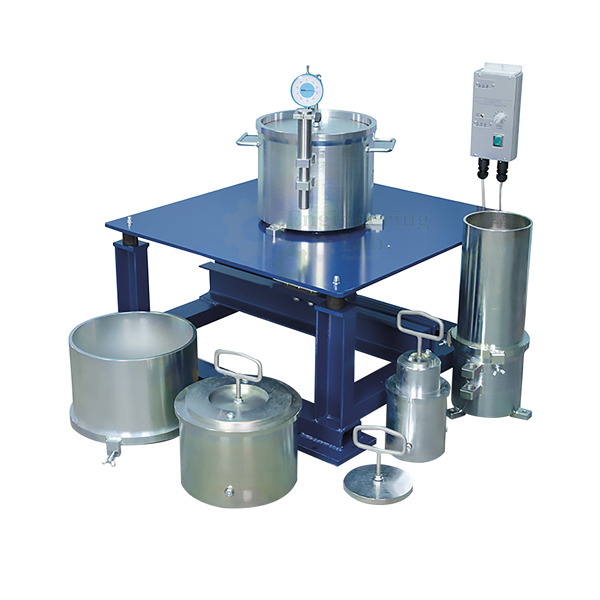
Relative Density Test Apparatus (code EL-STLE-10376) is a vibratory compaction set used to determine the relative density of granular soils. The set is built around a vibratory table with a cushioned steel deck of about 75 cm × 75 cm, cylindrical unit weight moulds of 3000 ml and 15000 ml capacity, a guide sleeve with clamp assembly, a surcharge base plate, handle and weight, and a 0.01 mm × 50 mm dial gauge, and it runs on a 415 V three phase supply.
Get a quote: use the Add To Cart enquiry button below, or send your quantity and delivery location through the contact page.
Specifications
| Parameter | Detail |
|---|---|
| Use | Determining the relative density of granular soils by vibratory compaction |
| Vibratory table | |
| Deck | Cushioned steel vibrating deck, about 75 cm × 75 cm |
| Frequency | Approximately 3600 vibrations per minute under a 11.5 kg load |
| Amplitude | Variable up to 0.65 mm in three steps: 0.05 to 0.25 mm, 0.25 to 0.45 mm and 0.45 to 0.65 mm |
| Power supply | 415 V, three phase |
| Moulds and surcharge | |
| Moulds | Cylindrical metal unit weight moulds of 3000 ml and 15000 ml capacity |
| Guide sleeve | With clamp assembly |
| Surcharge parts | Surcharge base plate for the mould, handle for the base plate, and surcharge weight |
| Surcharge load | Total weight with surcharge base plate and handle equivalent to 140 kg/cm² for the mould; for the 15000 ml mould, total weight with mould and surcharge weight equivalent to 140 kg/cm² |
| Measurement | |
| Dial gauge | 0.01 mm × 50 mm travel |
| Extension piece | 25 mm, for the dial gauge |
| Standards | IS 2720 (Part XIV), ASTM D 4253, ASTM D 4254 |
| Supply | |
| Product code | EL-STLE-10376 |
| Manufacturer | Engineering Lab Equipment, Ambala, Haryana, India |
What Is the Relative Density Test Apparatus Used For?
Relative density compares the density of a sand or gravel in place with its loosest and densest possible states, and it is used to judge how well a granular fill or foundation layer has been compacted. For the densest state, the operator fills the mould with dry soil, fits the guide sleeve, places the surcharge base plate and weight on top and vibrates the assembly on the table at the selected amplitude; the dial gauge then gives the settlement of the surcharge plate, from which the sample volume is found. The loosest state is found by placing the soil gently in the mould without vibration. The standards listed are IS 2720 (Part XIV), ASTM D 4253 and ASTM D 4254.
What to Specify When Ordering
- Quantity — the number of relative density sets required.
Frequently Asked Questions
What size is the vibrating deck?
The vibratory table has a cushioned steel vibrating deck of about 75 cm × 75 cm, running at approximately 3600 vibrations per minute under a 11.5 kg load.
Can the amplitude of vibration be adjusted?
Yes. The amplitude is variable up to 0.65 mm, in three steps covering 0.05 to 0.25 mm, 0.25 to 0.45 mm and 0.45 to 0.65 mm.
Which mould sizes are supplied?
Two cylindrical metal unit weight moulds are included, one of 3000 ml capacity and one of 15000 ml capacity, both used with the guide sleeve and clamp assembly.
How is the change in sample height measured?
A dial gauge of 0.01 mm × 50 mm travel, fitted with a 25 mm extension piece, reads the settlement of the surcharge base plate as the soil densifies.
What electrical supply does the vibratory table need?
The vibratory table and the rest of the apparatus are built for operation on a 415 V, three phase electrical supply.
Which test methods are listed for relative density?
For this vibratory apparatus, the standards listed are IS 2720 (Part XIV), ASTM D 4253 and ASTM D 4254.
OEM Manufacturer
Buyers of the Relative Density Test Apparatus deal directly with its maker, Engineering Lab Equipment (Engineering Labs Equipment Pvt Ltd), whose works are at Plot No. 43, Industrial Park, Sector 2, Growth Center, Saha, District Ambala, Haryana, India. The company designs, makes and tests soil testing equipment for classification, compaction, density, shear and consolidation tests, supplies engineering colleges, polytechnics, technical training institutes and research laboratories in India and overseas, and builds to institution-specific requirements on request. Tender details are on the Tenders/OEM page.
Related Soil Testing Equipment
- Sand Pouring Cylinder — cast aluminium sand replacement cylinder with funnel and shutter for field dry density of soils.
- Sand Density Cone Apparatus — double cone sand replacement set with plastic jars and base plate for field density.
- Automatic Soil Compactor — automatic rammer for standard, modified and CBR compaction with 2.5 or 4.5 kg rammer.
See the full Soil Testing Lab Equipment range or all Civil Engineering Lab Equipment.
Request a Quote
For this and other soil testing lab equipment, schools and colleges can contact Engineering Lab Equipment, a manufacturer, supplier and exporter based in Ambala, India. Quotations are given on request: send the number of relative density sets required and your delivery location through the contact page, or add the Relative Density Test Apparatus to the enquiry cart from this page.
Last updated: October 2026