
Working Model of ABS Braking System
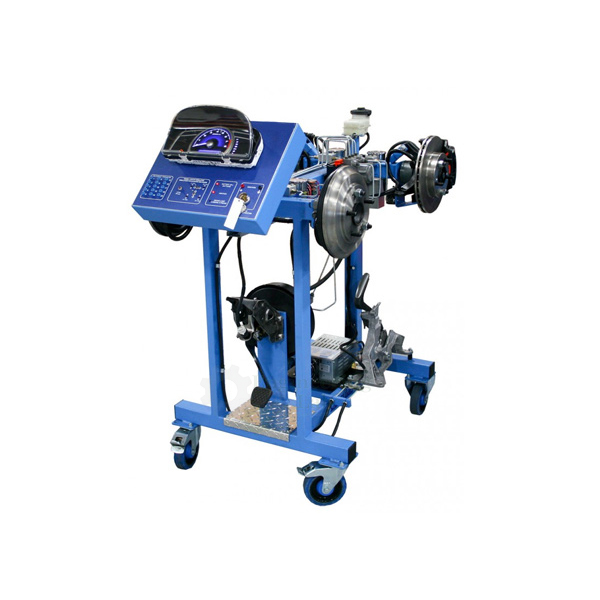
Product Code : EL-AELE-10742
Working Model of ABS Braking System (code EL-AELE-10742) is an ABS trainer, built from real automotive components, that demonstrates how an ABS braking system works on a real vehicle, with the instructor selecting which wheel combinations will lock up before the brake pedal is applied. A fully functional, cross diagonal 4-channel hydraulic system with ABS sits on a mobile powder coated stand with 2 front discs, 2 rear drums, pressure gauges at all 4 wheels, a lockable 6-fault box and a 55A DC power supply.
Get a quote: use the Add To Cart enquiry button below, or send your quantity and delivery location through the contact page.
Specifications
| Parameter | Detail |
|---|---|
| Use | Demonstrating ABS braking system operation as on a real vehicle |
| Components | Real automotive components |
| Hydraulic system | Fully functional, cross diagonal hydraulic braking system with 4-channel ABS, installed in a mobile solid frame |
| Wheel lock selection | Instructor selects manually which wheel combinations lock up before the brake pedal is applied |
| Hubs and brakes | Four hubs with brakes: 2 discs (front) and 2 drums (rear) |
| Pressure gauges | Hydraulic pressure gauge at each of the 4 wheels |
| Instrument panel | Vehicle instrument panel with indicator lamps |
| Breakout box | ABS control unit breakout box for hookup of a DVOM and oscilloscope |
| Fault box | Lockable fault insertion box, 6 faults |
| Parking brake | Fully functional parking brake system |
| Service work | All routine brake service procedures, including component replacement, adjustments and hydraulic bleeding |
| Service and repair systems | ABS electrical system with wheel speed sensors; ABS hydraulic control unit; front disc brakes; rear drum brakes; master cylinder and hydraulic system with pedal; parking brake system |
| Power requirement | 110 V at 20 A or 220 V at 10 A (to be specified when ordering) |
| DC supply | 55A DC power supply included |
| Stand | Powder coated metal stand with two locking swivel casters and two fixed casters |
| Dimensions | Approx. 800 × 800 × 1200 mm (L × W × H) |
| Weight | Approx. 65 kg |
| Product code | EL-AELE-10742 |
| Manufacturer | Engineering Lab Equipment, Ambala, Haryana, India |
What Is the Working Model of ABS Braking System Used For?
Under hard braking a locked wheel stops turning and can no longer steer the car, so ABS monitors the wheel speed sensors and, through the hydraulic control unit, releases and reapplies pressure at any wheel that is about to lock. The instructor chooses which wheel combinations should lock and then applies the pedal, while students watch the pressure gauge at each wheel and the indicator lamps on the instrument panel. Through the breakout box they test the control unit with a DVOM and oscilloscope and trace the inserted faults, and they also carry out routine brake work on the trainer: component replacement, adjustments and hydraulic bleeding.
What to Specify When Ordering
- Quantity — the number of ABS working models required.
- Power requirement — 110 V at 20 A or 220 V at 10 A, to suit the supply at the installation site.
Frequently Asked Questions
Can the instructor choose which wheels lock?
Yes, the instructor can manually select which wheel combinations are to lock up before the brake pedal is applied, to show how the ABS responds.
What brakes are fitted?
Four hubs carry brakes, 2 discs at the front and 2 drums at the rear, in a cross diagonal hydraulic circuit with a 4-channel ABS and a working parking brake.
Which electrical tests can be made?
The ABS control unit breakout box allows a DVOM and an oscilloscope to be connected, and a lockable fault insertion box provides 6 faults for diagnosis.
What service tasks can be practised?
All routine brake service procedures, including component replacement, adjustments and hydraulic bleeding, on the ABS electrical system and wheel speed sensors, hydraulic control unit, disc and drum brakes, master cylinder and parking brake.
What power supply does it need?
It needs 110 V at 20 amps or 220 V at 10 amps, to be specified when ordering, and a 55A DC power supply is included.
How is the trainer moved?
It stands on a powder coated metal frame with two locking swivel casters and two fixed casters, about 800 × 800 × 1200 mm in size and approximately 65 kg in weight.
OEM Manufacturer
Buyers of the Working Model of ABS Braking System deal directly with its maker, Engineering Lab Equipment (Engineering Labs Equipment Pvt Ltd), whose works are at Plot No. 43, Industrial Park, Sector 2, Growth Center, Saha, District Ambala, Haryana, India. The company designs, makes and tests automobile engineering cut-section models, working models and trainers, supplies engineering colleges, polytechnics, technical training institutes and research laboratories in India and overseas, and builds to institution-specific requirements on request. Tender details are on the Tenders/OEM page.
Related Automobile Engineering Equipment
- ABS Braking System Training Board Simulator — mobile aluminium-frame ABS board with per-wheel pressure gauges, fault-code jumpers and 16-pin OBD diagnosis.
- Working Model of Drive Shaft — motor-driven universal joint rig with selectable shaft angles, visual indicators and toothed wheels for audible speed change.
- Air Bag Trainer — training panel for SRS air bag work with light-simulated deployment, 10-fault lockable box and breakout test points.
- Working Model of Power Steering with Suspension — electrical rack and pinion steering on a car front axle with McPherson struts, CAN body computer and displays.
See the full Automobile Engineering Lab Equipment range or all Mechanical Engineering Lab Equipment.
Request a Quote
For this and other automobile engineering lab equipment, schools and colleges can contact Engineering Lab Equipment, a manufacturer, supplier and exporter based in Ambala, India. Quotations are given on request: send the number of ABS working models and the supply voltage, 110 V or 220 V and your delivery location through the contact page, or add the Working Model of ABS Braking System to the enquiry cart from this page.
Last updated: October 2026


