Redundant Joint Truss Apparatus
Product Code : EL-SELE-10578
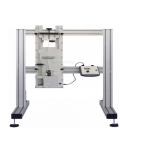
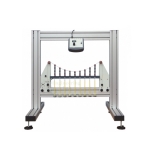
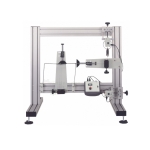
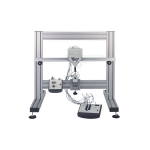
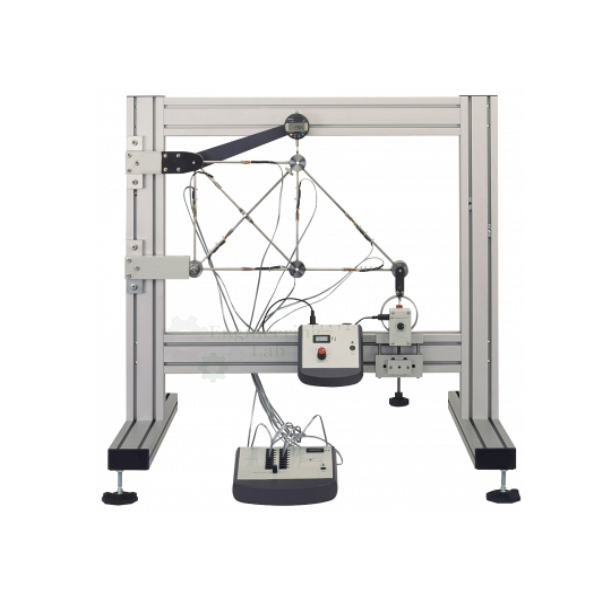
Redundant Joint Truss Apparatus (code EL-SELE-10578) is an experiment for investigating redundancy and aspects of safety critical structures by comparing a determinate and an indeterminate framed structure. On a Structures Test Frame, two supports hold one side of the frame, load is applied through a screw thread and electronic load cell shown on a Digital Force Display, strain gauges on every member are read on a digital strain bridge, and a digital deflection indicator measures displacement.
Get a quote: use the Add To Cart enquiry button below, or send your quantity and delivery location through the contact page.
Specifications
| Parameter | Detail |
|---|---|
| Use | Investigating the principles of redundancy and aspects of safety critical structures, using determinate and indeterminate framed structures |
| Intended users | Engineering students in mechanical, civil and structural courses |
| Frame | Structures Test Frame |
| Supports | Two, holding the top and base of one side of the structure; top support pivots, base support pivots and rolls |
| Determinate set-up | One member left out of the structure |
| Indeterminate set-up | Missing member refitted |
| Loading | Applied manually to one end of the framework by a screw thread and electronic load cell |
| Load display | Digital Force Display connected to the load cell |
| Strain measurement | Gauges fitted to every member, each wired to a digital strain bridge |
| Displacement | Digital deflection indicator |
| Documentation | Operation Manual describing the equipment and procedures, with sample experiment results |
| Software options | Optional extras: the Structures Software package with simulating virtual experiments, and a data acquisition unit that includes it for automatic recording |
| Product code | EL-SELE-10578 |
| Manufacturer | Engineering Lab Equipment, Ambala, Haryana, India |
What Is the Redundant Joint Truss Apparatus Used For?
A determinate frame has just enough members to be stable, so its member forces follow from equilibrium alone, while an indeterminate frame has a redundant member and shares load in a way that also depends on member stiffness. Students first load the frame with one member removed, turning the screw thread and noting the load from the Digital Force Display, the member strains from the strain bridge and the displacement from the deflection indicator, and use the strains to calculate member forces. They then refit the missing member, repeat the test and compare how the redundant member changes forces and deflection.
What to Specify When Ordering
- Quantity — the number of redundant truss sets required.
- Optional software — the Structures Software package on its own, or the unit that adds automatic data acquisition, if either is wanted.
Frequently Asked Questions
What principle does the Redundant Joint Truss Apparatus demonstrate?
It demonstrates redundancy in framed structures, and aspects of safety critical design, by testing the same frame as a determinate structure and then as an indeterminate one.
How is the structure made determinate or indeterminate?
It starts with one member missing, which makes it determinate; students then refit the missing member to make the structure indeterminate and repeat the test.
How is the frame supported and loaded?
Two supports hold the top and base of one side, the top one pivoting and the base one pivoting and rolling, and load is applied by hand through a screw thread and load cell.
What measurements are taken?
The Digital Force Display shows the applied load, a digital strain bridge shows the strains from gauges on each member, and a digital deflection indicator measures displacement.
Why compare determinate and indeterminate frames?
A redundant member gives the structure another load path, so comparing the two tests shows how forces redistribute and how a frame can still stand if one member fails.
Is software available?
An optional Structures Software package offers extra virtual experiments, and an optional unit including it provides automatic data acquisition of the test readings.
OEM Manufacturer
The Redundant Joint Truss Apparatus is made by Engineering Lab Equipment (Engineering Labs Equipment Pvt Ltd) at its works at Plot No. 43, Industrial Park, Sector 2, Growth Center, Saha, District Ambala, Haryana, India. The company designs, makes and tests structural engineering trainers for beams, frames, trusses and columns for engineering colleges, polytechnics, technical training institutes and research laboratories in India and overseas, and can build equipment to an institution's own requirements. Tender and OEM enquiries are handled through the Tenders/OEM page.
Related Structural Engineering Equipment
- Bending Stress In a Beam with Data Acquisition — bending experiment on a T-beam with load cell, strain gauges and digital strain bridge for a test frame.
- Unsymmetrical Bending Apparatus — angle-section cantilever on a stand with rotating clamp, weights and 25 mm dial gauge.
- Portal Frame Apparatus with Data Acquisition — plastic collapse experiment for portal frames with screw loading, force display and two deflection indicators.
See the full Structural Engineering Lab Equipment range or all Civil Engineering Lab Equipment.
Request a Quote
For this and other structural engineering lab equipment, schools and colleges can contact Engineering Lab Equipment, a manufacturer, supplier and exporter based in Ambala, India. To ask for a quotation, send the number of redundant truss sets and whether the software option is wanted and your delivery location through the contact page, or use the Add To Cart enquiry button on this page.
Last updated: October 2026