Computerized Cam Analysis
Product Code : EL-DOMLE-10769
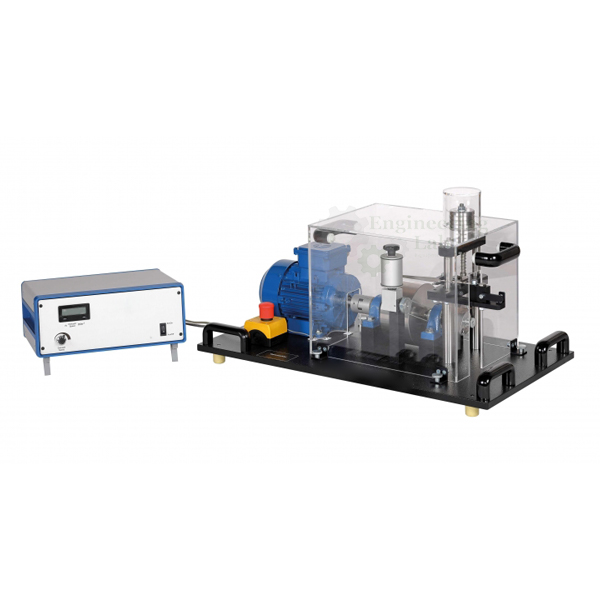
Computerized Cam Analysis (code EL-DOMLE-10769) is a teaching unit for investigating how a cam mechanism behaves dynamically at different speeds, comparing four cam members and two engaging members by their motion. A 250 W motor with frequency converter and large flywheel turns the cams at 60-670 min-1, a mass and one of 3 return springs simulate a valve, and a recorder synchronised with the cam records the actual elevation curve for comparison with theory.
Get a quote: use the Add To Cart enquiry button below, or send your quantity and delivery location through the contact page.
Specifications
| Parameter | Detail |
|---|---|
| Purpose | Demonstration of cam mechanism dynamics in engineering education; not suitable as a test bench for endurance testing or tribology |
| Cam members | Tangent cam, hollow cam, 2 circular arm cams with different head radius |
| Cam stroke | 15 mm each |
| Opening angle | 140° each |
| Engaging members | Flat receiver with plunger or rolling receiver with plunger |
| Valve simulation | Mass and spring |
| Return springs | 3, interchangeable, with spring preload |
| Spring stiffness | Hard 5,026 N/m; medium 2,601 N/m; soft 613 N/m |
| Oscillating mass | Can be increased with 5 additional weights; additional masses supplied with different weights |
| Drive motor | DC asynchronous motor with frequency converter, 250 W |
| Speed | 60–670 min-1 |
| Flywheel | Large flywheel to keep the speed as constant as possible |
| Speed sensor | Optical |
| Recorder | Toothed belt drive, synchronised with the cam member; records the actual elevation curve |
| Guarding | Transparent protective cover; open design leaves the motion visible |
| Experiments | Elevation curves of different cam shapes compared with each other and with theory; limit speed compared with theory; influence of spring stiffness, preload and moving mass on cam member/plunger motion |
| Power supply | 230 V, 50 Hz, 1 phase; 230 V, 60 Hz, 1 phase; or 120 V, 60 Hz, 1 phase |
| Dimensions | 800 × 600 × 500 mm approx. (L × W × H) |
| Weight | 85 kg |
| Product code | EL-DOMLE-10769 |
| Manufacturer | Engineering Lab Equipment, Ambala, Haryana, India |
What Is the Computerized Cam Analysis Used For?
A cam mechanism of the kind that opens an engine valve lifts its follower through a set elevation curve, but at high speed the follower and spring can no longer keep up, and the speed at which this begins is the limit speed. Students mount one of the cams and engaging members, select a return spring and preload, add weights to the oscillating mass and run the motor at increasing speeds. The synchronised recorder draws the real elevation curve at each setting, which they compare with the theoretical curve and with the other cam shapes, and they find the limit speed for each combination and how spring stiffness and moving mass shift it.
What to Specify When Ordering
- Quantity — the number of units required.
- Power supply — 230 V 50 Hz, 230 V 60 Hz or 120 V 60 Hz, single phase.
Frequently Asked Questions
Which cam members and engaging members are included?
Four cam members are included: a tangent cam, a hollow cam and a pair of circular arm cams that differ in head radius, run against a flat or a rolling receiver, each with plunger.
How is the valve of an engine represented?
The valve is simulated with a mass and a spring; three interchangeable return springs with spring preload are supplied, and the oscillating mass can be increased with 5 additional weights.
What spring stiffnesses are available?
The return springs are hard at 5,026 N/m, medium at 2,601 N/m and soft at 613 N/m.
What speed range does the drive cover?
The 250 W drive motor with frequency converter runs from 60 to 670 min-1, and a large flywheel keeps the speed as constant as possible.
How is the elevation curve recorded?
The recorder, driven by toothed belt in step with the cam member, traces the real elevation curve of the mechanism for comparison with theory.
What should be included in an export enquiry?
Include the quantity, the destination country with the port or city of delivery, the preferred delivery terms such as FOB or CIF, packing requirements, and the tender reference where one applies.
OEM Manufacturer
Buyers of the Computerized Cam Analysis deal directly with its maker, Engineering Lab Equipment (Engineering Labs Equipment Pvt Ltd), whose works are at Plot No. 43, Industrial Park, Sector 2, Growth Center, Saha, District Ambala, Haryana, India. The company designs, makes and tests dynamics of machines apparatus such as governors, gyroscopes, cams and balancing machines, supplies engineering colleges, polytechnics, technical training institutes and research laboratories in India and overseas, and builds to institution-specific requirements on request. Tender details are on the Tenders/OEM page.
Related Dynamics of Machines Equipment
- Cam Analysis Apparatus — motor-driven cam and follower rig with four cams, two followers, springs and lift sensors.
- Scotch Yoko Mechanism — hand-cranked slotted link model showing crank rotation against yoke travel.
- Free and Forced Vibration Apparatus — bar-type oscillator trainer with three coil springs, oil damper, two exciters and drum recorder.
See the full Dynamics of Machine Lab Equipment range or all Mechanical Engineering Lab Equipment.
Request a Quote
For this and other dynamics of machine lab equipment, schools and colleges can contact Engineering Lab Equipment, a manufacturer, supplier and exporter based in Ambala, India. Quotations are given on request: send the number of units and the supply voltage and frequency and your delivery location through the contact page, or add the Computerized Cam Analysis to the enquiry cart from this page.
Last updated: October 2026