Compressible Flow Unit
Product Code : EL-FMLE-10653
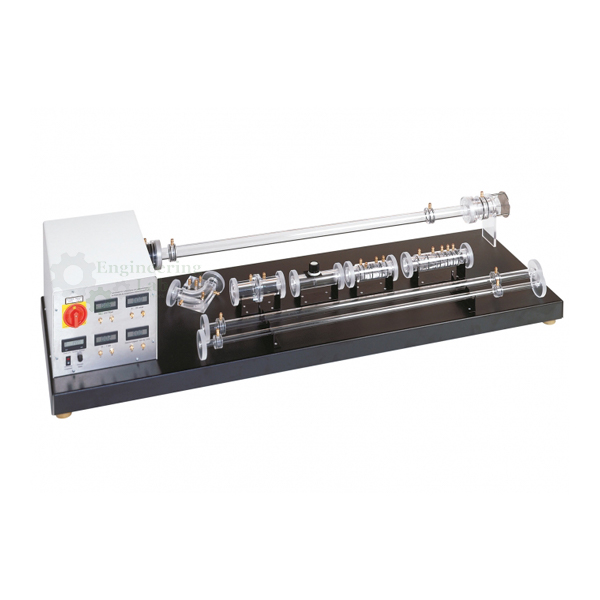
Compressible Flow Unit (code EL-FMLE-10653) is a teaching apparatus for investigating the flow of a compressible fluid, using a variable-speed radial fan that draws air from the room through a measuring nozzle and a set of interchangeable, transparent measuring objects. The fan reaches 31000 min-1, 226 m³/h and 318 mbar head, and the objects include a 1 m pipe section in 16, 24 and 34 mm diameters, a 90° elbow, two nozzles and an orifice with four disks.
Get a quote: use the Add To Cart enquiry button below, or send your quantity and delivery location through the contact page.
Specifications
| Parameter | Detail |
|---|---|
| Use | Teaching the concepts of compressible flow, including subsonic and transonic air flow |
| Air supply | Radial fan with infinitely variable speed, drawing in air from the environment; speed sets the mass flow rate |
| Intake | Measuring nozzle at the intake, accelerating the airflow and used to determine the mass flow rate |
| Measuring objects | Interchangeable, made of transparent material, with connectors for pressure measurement |
| Turbulence | Minimised by drawing the air in and by the arrangement of the measuring objects on the intake side of the fan |
| Volumetric flow | Orifice for determining the volumetric flow rate by differential pressure measurement |
| Fan characteristic | Recorded using a throttle valve |
| Displays | Digital displays for pressures, velocity and speed |
| Investigations | Pressure losses in subsonic flow in pipe elbows and various pipe sections; pressure curve in subsonic and transonic nozzle flow |
| Radial fan | |
| Maximum speed | 31000 min-1 |
| Maximum volumetric flow rate | 226 m³/h |
| Maximum head | 318 mbar |
| Maximum power consumption | 1,8 kW |
| Measuring objects | |
| Pipe section | 1 m; diameter 16, 24 and 34 mm |
| Pipe elbow | 90° |
| Nozzles | 2, inner diameter 12 to 34 mm |
| Enlargements | With sudden enlargement; with gradual enlargement (de Laval nozzle) |
| Orifice | With orifice disks of diameter 12, 19, 25 and 32 mm |
| Throttle valve | Diameter 34 mm |
| Measuring ranges | |
| Speed | 0 to 99999 min-1 |
| Pressure | 1 × 0 to 25 mbar, 1 × 0 to 600 mbar, 1 × 0 to 1000 mbar |
| Velocity | 0 to 65 m/s |
| Power supply, size and weight | |
| Power supply | 230 V, 50 Hz, 1 phase |
| L × W × H | 900 × 650 × 800 mm |
| Weight | 120 kg |
| Supply | |
| Product code | EL-FMLE-10653 |
| Manufacturer | Engineering Lab Equipment, Ambala, Haryana, India |
What Is the Compressible Flow Unit Used For?
When air moves fast enough for its density to change noticeably, pressure and velocity are no longer linked in the simple way seen with water, and nozzle flow can approach or reach the speed of sound. Students set the fan speed to fix the mass flow, read it from the intake measuring nozzle and fit the pipe sections, elbow, nozzles or orifice in turn, taking pressures through the connectors on each transparent object. The digital displays give the pressures, velocity and speed needed to plot pressure losses and nozzle pressure curves for subsonic and transonic flow, and closing the throttle valve in steps traces the fan characteristic curve.
What to Specify When Ordering
- Quantity — the number of units required.
Frequently Asked Questions
What flow regimes can be studied?
The unit is used to investigate compressible air flow in the subsonic and transonic ranges, including the pressure curve through nozzles and the pressure losses in pipe elbows and pipe sections.
What drives the air through the measuring section?
A radial fan with infinitely variable speed draws the air in from the surroundings. It reaches a maximum of 31000 min-1, 226 m³/h and 318 mbar head, with a maximum power consumption of 1,8 kW.
Which measuring objects are included?
A 1 m pipe section in 16, 24 and 34 mm diameters, a 90° pipe elbow, two nozzles of 12 to 34 mm inner diameter, an orifice with 12, 19, 25 and 32 mm disks, and a 34 mm throttle valve.
How are mass flow and volumetric flow measured?
A measuring nozzle at the intake is used to determine the mass flow rate, and an orifice gives the volumetric flow rate by differential pressure measurement.
What can the displays read?
Digital displays show pressures, velocity and speed. Speed reads 0 to 99999 min-1, velocity 0 to 65 m/s, and three pressure ranges cover 0 to 25, 0 to 600 and 0 to 1000 mbar.
Why is the air drawn in rather than blown through?
Drawing the air in, with the measuring objects arranged on the intake side of the fan, keeps turbulence to a minimum as the flow enters each object.
OEM Manufacturer
The Compressible Flow Unit is made by Engineering Lab Equipment (Engineering Labs Equipment Pvt Ltd) at its works at Plot No. 43, Industrial Park, Sector 2, Growth Center, Saha, District Ambala, Haryana, India. The company designs, makes and tests fluid mechanics apparatus for flow measurement, pipe friction, pumps and hydrostatics for engineering colleges, polytechnics, technical training institutes and research laboratories in India and overseas, and can build equipment to an institution's own requirements. Tender and OEM enquiries are handled through the Tenders/OEM page.
Related Fluid Mechanics Equipment
- Subsonic Wind Tunnel — bench-top subsonic tunnel with 150 mm square clear working section and air speeds up to 34 m/s.
- Orifice and Venturi Meter Demonstration — bench unit pairing Venturi and orifice plate with a 2 to 30 l/min flow meter for Cd tests.
- Pitot Tube Apparatus — traversing Pitot static tube in a 32 mm transparent pipe with pressurised water manometer for velocity profiles.
See the full Fluid Mechanics Lab Equipment range or all Mechanical Engineering Lab Equipment.
Request a Quote
For this and other fluid mechanics lab equipment, schools and colleges can contact Engineering Lab Equipment, a manufacturer, supplier and exporter based in Ambala, India. To ask for a quotation, send the number of compressible flow units required and your delivery location through the contact page, or use the Add To Cart enquiry button on this page.
Last updated: October 2026