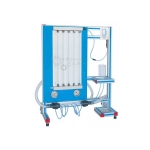
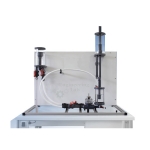
Energy Losses in Pipes

Product Code : EL-FMLE-10657
Energy Losses in Pipes (code EL-FMLE-10657) is a trainer for investigating the pressure losses that pipe friction, bends, valves, fittings and changes of section cause in flowing water. It has ten 1000 mm pipe sections, including straight copper, galvanised steel and PVC pipes, a section with three types of bend, two valve and fitting sections, two contraction and enlargement sections and a parallel dual line, read with a differential pressure meter, manometers and a Rota meter covering 0 to 1600 L/h.
Get a quote: use the Add To Cart enquiry button below, or send your quantity and delivery location through the contact page.
Specifications
| Parameter | Detail |
|---|---|
| Use | Investigating pressure losses in pipes and pipe elements through which water flows |
| Pipe sections | Ten, with different pipe elements; length 1000 mm |
| Straight sections | Four, of constant cross-section, differing in material and cross-section |
| Straight pipes | Cu 18 × 1 mm; galvanised steel ½ in; PVC 20 × 1,5 mm; PVC 32 × 1,5 mm |
| Flow diversion section | Pipe bend, pipe angle and segment bend |
| Valve and fitting sections | Two, with various shut-off valves and fittings of different resistance; opening characteristics determined in the experiment |
| Contraction and enlargement | Two sections with gradual and sudden contractions and enlargements |
| Enlargement | Gradual/sudden, diameter from 20 to 32 mm |
| Contraction | Gradual/sudden, diameter from 32 to 20 mm |
| Dual line | Parallel dual line, PVC, diameter 20 × 1,5 mm |
| Pressure measuring points | Annular chambers directly upstream and downstream of the pipe elements |
| Pressure readout | Sensors connected in pairs to a differential pressure meter, a manometer panel or twin tube manometers |
| Flow measurement | Rota meter |
| Section selection | Hose connections with quick-release coupling |
| Experiments | Pressure losses in pipe elements; comparison of losses in similar components; different types of pressure measurement |
| Differential pressure | |
| Differential pressure meter | 0 to 2000 mbar |
| Twin tube manometer | 1000 mmWC |
| 6 tube manometers | 340 mmWC |
| Measuring ranges | |
| Flow rate | 0 to 1600 L/h |
| Dimensions and weight | |
| L × W × H | 600 × 400 × 600 mm |
| Weight | 60 kg |
| Supply | |
| Product code | EL-FMLE-10657 |
| Manufacturer | Engineering Lab Equipment, Ambala, Haryana, India |
What Is the Energy Losses in Pipes Used For?
Every length of pipe, bend, valve and change of section takes energy from a flowing liquid, and the resulting head loss has to be known when pumps and pipework are sized. Students select a pipe section through its quick-release hose connections, set a flow on the Rota meter and read the pressure difference across the element from the annular-chamber tappings on the differential pressure meter, the manometer panel or the twin tube manometer. Repeating this over a range of flows lets them compare friction in copper, steel and PVC pipe, the losses in bends and fittings, the opening characteristics of the valves and the effect of sudden and gradual changes of diameter.
What to Specify When Ordering
- Quantity — the number of trainers required.
Frequently Asked Questions
How many pipe sections does the trainer have?
It has ten 1000 mm pipe sections: four straight, one with three flow diversions, two with valves and fittings, two with contractions and enlargements, and a parallel dual line.
Which straight pipe materials are included?
The straight sections are copper 18 × 1 mm, galvanised steel ½ in, and PVC in 20 × 1,5 mm and 32 × 1,5 mm sizes, so friction losses can be compared by material and diameter.
How is the pressure loss across each element read?
Annular-chamber measuring points sit directly upstream and downstream of each element and connect in pairs to a 0 to 2000 mbar differential pressure meter, a 1000 mmWC twin tube manometer or 340 mmWC tube manometers.
What changes of diameter can be studied?
Gradual and sudden enlargements go from 20 to 32 mm, and gradual and sudden contractions go from 32 to 20 mm, in two dedicated pipe sections of the trainer.
What flow range is measured?
Flow is displayed on a Rota meter with a measuring range of 0 to 1600 L/h, which sets the conditions for each pressure loss reading.
What details help with an export enquiry for this trainer?
State the quantity, the destination country and the port or city of delivery, the delivery terms wanted such as FOB or CIF, any packing requirements and the tender reference if there is one.
OEM Manufacturer
Engineering Lab Equipment (Engineering Labs Equipment Pvt Ltd) builds the Energy Losses in Pipes at its works in Saha, District Ambala, Haryana (Plot No. 43, Industrial Park, Sector 2, Growth Center). Its fluid mechanics apparatus for flow measurement, pipe friction, pumps and hydrostatics go to engineering colleges, polytechnics, technical training institutes and research laboratories in India and abroad, and equipment can be made to an institution's own requirements. For tenders and OEM supply, see the Tenders/OEM page.
Related Fluid Mechanics Equipment
- Pipe Network Apparatus — freestanding PVC pipe network with isolating valves, 6 to 14 mm pipes and digital pressure meter.
- Pipe Surge and Water Hammer Apparatus — two 3 m stainless steel test pipes with surge shaft, fast acting valve and pressure sensors.
- Orifice and Venturi Meter Demonstration — bench unit pairing Venturi and orifice plate with a 2 to 30 l/min flow meter for Cd tests.
See the full Fluid Mechanics Lab Equipment range or all Mechanical Engineering Lab Equipment.
Request a Quote
For this and other fluid mechanics lab equipment, schools and colleges can contact Engineering Lab Equipment, a manufacturer, supplier and exporter based in Ambala, India. For a price, send the number of pipe loss trainers required and the delivery location through the contact page; the Add To Cart button on this page also adds the Energy Losses in Pipes to an enquiry.
Last updated: October 2026