
Osborne Reynolds Demonstration
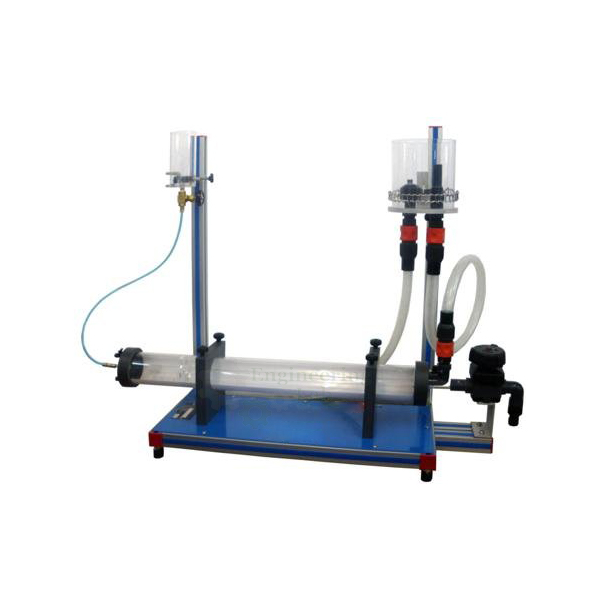
Product Code : EL-FMLE-10671
Osborne Reynolds Demonstration (code EL-FMLE-10671) is a flow visualisation apparatus used to show laminar, transition and turbulent flow in a pipe and to relate each regime to its Reynolds number. Water from a constant-pressure supply tank enters a transparent, horizontal methacrylate test pipe of 16 mm bore, 20 mm outside diameter and 750 mm length through an airfoil-shaped inlet, while dye from a 0.4 ltr tank is injected through a needle valve.
Get a quote: use the Add To Cart enquiry button below, or send your quantity and delivery location through the contact page.
Specifications
| Parameter | Detail |
|---|---|
| Use | Studying the characteristics of liquid flow in a pipe and determining the Reynolds number for laminar, transition and turbulent flow |
| Water supply | Hydraulics Bench or Basic Hydraulic Feed System |
| Supply tank | Water supply tank with level fitting and feed connection, keeping the flow homogeneous; section giving a constant pressure at the tank inlet |
| Dye tank | Dye or vegetable colouring tank with valve and injection needle, connected by a hose; capacity 0.4 ltr |
| Dye injection control | Needle valve |
| Flow control | Control valve to adjust the water flow |
| Coupling | Quick coupling system built in |
| Structure | Anodized aluminium structure with painted steel panel |
| Experiments | Observation of laminar, transition and turbulent flows; association of each with its Reynolds number; observation of the parabolic velocity profile |
| Methacrylate test pipe with airfoil-shaped inlet | |
| Inner diameter | 16 mm |
| External diameter | 20 mm |
| Length | 750 mm |
| Capacity | 2.4 ltr |
| Dimensions and weight | |
| L × W × H | 600 × 600 × 1000 mm |
| Weight | 40 kg |
| Supply | |
| Product code | EL-FMLE-10671 |
| Manufacturer | Engineering Lab Equipment, Ambala, Haryana, India |
What Is the Osborne Reynolds Demonstration Used For?
The Reynolds number compares inertial and viscous forces in a flow: at low values the fluid moves in smooth layers, at high values it mixes in eddies, and between the two lies a transition range. Students open the control valve a little, release dye through the needle and watch it run as a straight, unbroken thread, then raise the flow in steps until the thread wavers and finally breaks up across the pipe. At each setting they measure the flow rate and work out the Reynolds number from the 16 mm bore, and a dye front released into slow flow shows the parabolic velocity profile.
What to Specify When Ordering
- Quantity — the number of apparatus required.
- Water supply — whether the unit will be fed from a Hydraulics Bench or from a Basic Hydraulic Feed System.
Frequently Asked Questions
Which flow regimes can be seen?
Laminar, transition and turbulent flow can all be observed in the transparent test pipe, and each is associated with its corresponding Reynolds number.
How is the dye introduced?
Dye or vegetable colouring flows from a 0.4 ltr tank through a hose to an injection needle, and the rate of injection is set with a needle valve.
What are the test pipe dimensions?
The methacrylate test pipe has a 16 mm inner diameter, a 20 mm external diameter and a length of 750 mm, with an airfoil-shaped inlet section.
What does the supply tank do?
The supply tank keeps the flow entering the pipe homogeneous, and a section of it generates a constant pressure at the tank inlet. It has a level fitting and a connection for its feed.
Can the velocity profile be seen?
Yes. Observation of the parabolic velocity profile is one of the listed experiments, made visible by the dye in the transparent pipe during laminar flow.
Where does the water come from?
Water is supplied either from the Hydraulics Bench or from the Basic Hydraulic Feed System, and a control valve adjusts the flow through the test section.
OEM Manufacturer
The Osborne Reynolds Demonstration is made by Engineering Lab Equipment (Engineering Labs Equipment Pvt Ltd) at its works at Plot No. 43, Industrial Park, Sector 2, Growth Center, Saha, District Ambala, Haryana, India. The company designs, makes and tests fluid mechanics apparatus for flow measurement, pipe friction, pumps and hydrostatics for engineering colleges, polytechnics, technical training institutes and research laboratories in India and overseas, and can build equipment to an institution's own requirements. Tender and OEM enquiries are handled through the Tenders/OEM page.
Related Fluid Mechanics Equipment
- Pipe Network Apparatus — freestanding PVC pipe network with isolating valves, 6 to 14 mm pipes and digital pressure meter.
- Energy Losses in Pipes — ten-section pipe friction trainer with copper, steel and PVC pipes, bends, valves and differential pressure meter.
- Orifice and Venturi Meter Demonstration — bench unit pairing Venturi and orifice plate with a 2 to 30 l/min flow meter for Cd tests.
See the full Fluid Mechanics Lab Equipment range or all Mechanical Engineering Lab Equipment.
Request a Quote
For this and other fluid mechanics lab equipment, schools and colleges can contact Engineering Lab Equipment, a manufacturer, supplier and exporter based in Ambala, India. To ask for a quotation, send the number of apparatus and the water supply they will run from and your delivery location through the contact page, or use the Add To Cart enquiry button on this page.
Last updated: October 2026


