Computerized Emissivity Measurement Apparatus
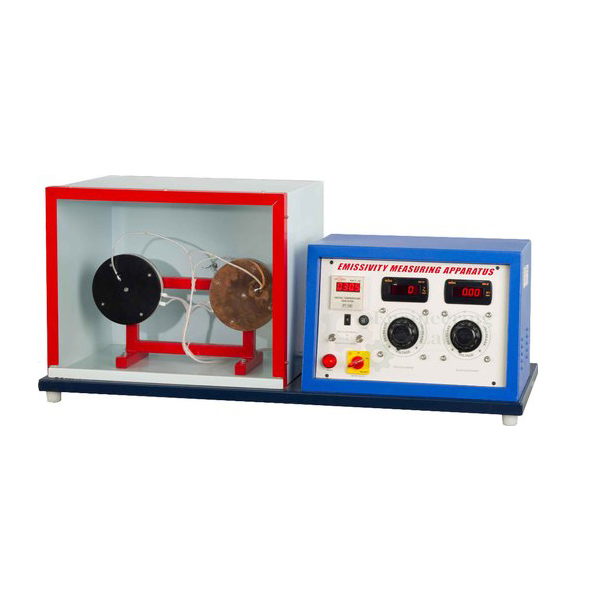
Product Code : EL-HAMTLE-10754
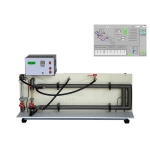
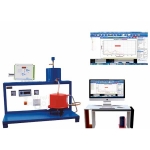
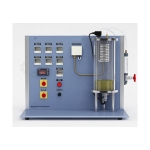
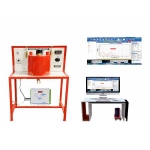
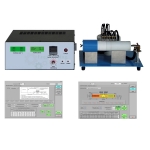
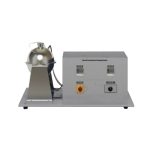
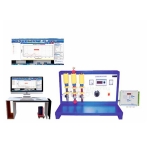
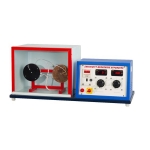
Computerized Emissivity Measurement Apparatus (code EL-HAMTLE-10754) is a trainer for experiments on heat transfer by radiation, in which a metallic sample is heated by a light beam from a continuously adjustable 150 W halogen lamp, concentrated by a parabolic reflector. A thermopile on a moveable carriage measures the radiation emitted at different distances, aluminium, copper and steel samples of 20 mm diameter with different surfaces are used, and the unit connects to a PC via USB.
Get a quote: use the Add To Cart enquiry button below, or send your quantity and delivery location through the contact page.
Specifications
| Parameter | Detail |
|---|---|
| Use | Basic experiments on heat transfer by radiation |
| Heat source | Continuously adjustable halogen lamp; parabolic reflector concentrates the radiation to a focal point |
| Sample mounting | Sample placed on a thermocouple at the focal point |
| Radiation measurement | Thermopile on a moveable carriage, for measurement at different distances |
| Instrumentation | Microprocessor-based, housed in the unit |
| PC connection | USB |
| Software functions | Educational software, data acquisition, system operation |
| Experiments | Effect of different surfaces on radiation heat transfer; fundamentals of heat transfer; transient behaviour; power balances |
| Laws verified | Lambert's inverse-square law, Stefan-Boltzmann law, Kirchhoff's law |
| Halogen lamp | |
| Electrical power | 150 W |
| Max. temperature | Approx. 560 °C |
| Samples, 20 mm diameter | |
| Aluminium | 1 × matt anodised on both sides; 1 × painted on both sides (high-temperature paint); 1 × matt anodised with one painted side |
| Copper | 1 × nickel-plated; 1 × heavily oxidised |
| Steel | 1 × heavily oxidised |
| Measuring ranges | |
| Temperature | 0–780 °C |
| Radiation intensity | 0–1250 W/m² |
| Requirements, dimensions and weight | |
| Power supply | 230 V, 50 Hz, 1 phase; 230 V, 60 Hz, 1 phase; 120 V, 60 Hz, 1 phase |
| Dimensions (L × W × H) | Approx. 700 × 450 × 400 mm |
| Weight | Approx. 20 kg |
| Supply | |
| Product code | EL-HAMTLE-10754 |
| Manufacturer | Engineering Lab Equipment, Ambala, Haryana, India |
What Is the Computerized Emissivity Measurement Apparatus Used For?
Every surface gives off thermal radiation according to its temperature and its emissivity, and dull, oxidised or painted surfaces radiate much more than bright metal at the same temperature. Students place each sample on the thermocouple at the focal point, heat it with the halogen lamp and read the emitted radiation with the thermopile. Comparing the anodised, painted, nickel-plated and oxidised samples shows the effect of the surface; moving the thermopile carriage tests the inverse-square law; and relating radiation to sample temperature checks the Stefan-Boltzmann law. Readings across a heating run give the transient behaviour and a power balance, logged through the software.
What to Specify When Ordering
- Quantity — the number of emissivity trainers required.
- Supply voltage — 230 V at 50 Hz, 230 V at 60 Hz or 120 V at 60 Hz, all single phase.
Frequently Asked Questions
How is the sample heated?
A continuously adjustable 150 W halogen lamp produces a light beam that a parabolic reflector concentrates onto the sample, which sits on a thermocouple at the focal point.
How is the emitted radiation measured?
A thermopile measures the thermal radiation given off by the sample. It rides on a moveable carriage, so readings can be taken at different distances from the sample.
Which samples are provided?
There are 20 mm diameter samples in aluminium (matt anodised, painted, and anodised with one painted side), copper (nickel-plated and heavily oxidised) and steel (heavily oxidised).
Which laws can be verified?
The experiments verify Lambert's inverse-square law, the Stefan-Boltzmann law and Kirchhoff's law, and they also cover transient behaviour and power balances.
Why do the samples have different surfaces?
Emissivity depends on the surface: dull, oxidised or painted surfaces emit far more thermal radiation than bright metallic ones at the same temperature, and the set of finishes lets this be compared.
How does radiation differ from conduction and convection?
Radiation carries heat as electromagnetic waves and needs no material medium, so it can pass through a vacuum, whereas conduction and convection need a solid, liquid or gas.
OEM Manufacturer
Buyers of the Computerized Emissivity Measurement Apparatus deal directly with its maker, Engineering Lab Equipment (Engineering Labs Equipment Pvt Ltd), whose works are at Plot No. 43, Industrial Park, Sector 2, Growth Center, Saha, District Ambala, Haryana, India. The company designs, makes and tests heat and mass transfer apparatus for conduction, convection, radiation and heat exchangers, supplies engineering colleges, polytechnics, technical training institutes and research laboratories in India and overseas, and builds to institution-specific requirements on request. Tender details are on the Tenders/OEM page.
Related Heat and Mass Transfer Equipment
- Computerized Stefan Boltzman Apparatus — vacuum and pressure vessel trainer separating radiation and convection from a heated metal cylinder.
- Guarded Hot Plate with Data Acquisition — bench-top guarded hot plate unit for thermal conductivity of non-metallic specimens, 500 W heaters.
- Computerized Boiling Heat Transfer Apparatus — fire tube boiling trainer with transparent 10 L tank, 250 W heater and USB data logging.
See the full Heat and Mass Transfer Lab Equipment range or all Mechanical Engineering Lab Equipment.
Request a Quote
For this and other heat and mass transfer lab equipment, schools and colleges can contact Engineering Lab Equipment, a manufacturer, supplier and exporter based in Ambala, India. Quotations are given on request: send the number of trainers and the supply voltage and frequency they must run on and your delivery location through the contact page, or add the Computerized Emissivity Measurement Apparatus to the enquiry cart from this page.
Last updated: October 2026