
Evaporating Dishes
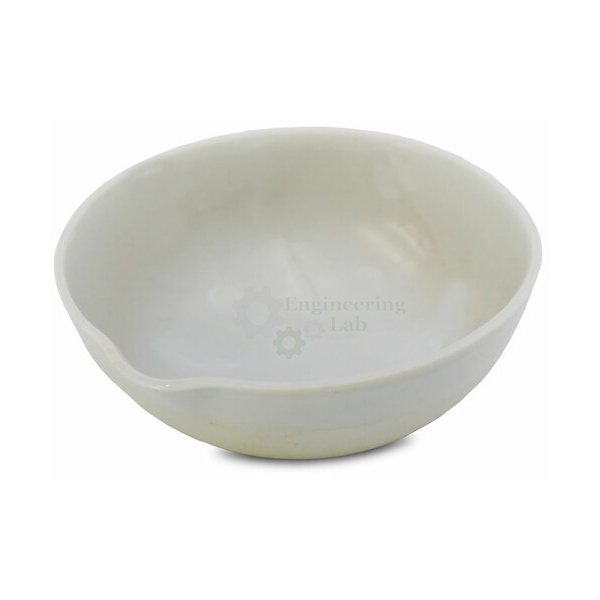
Product Code : EL-LEAA-10530
Evaporating Dishes (code EL-LEAA-10530) are shallow open vessels used to drive off the liquid from a solution or supernatant, leaving either a stronger solution or the dissolved substance as a solid. The relatively flat shell spreads the liquid over a large surface and has a pouring spout for transferring the sample. Porcelain and borosilicate glass, both non-reactive and able to take Bunsen burner heat, are the usual materials, with glassy carbon and PTFE dishes also available.
Get a quote: use the Add To Cart enquiry button below, or send your quantity and delivery location through the contact page.
Specifications
| Parameter | Detail |
|---|---|
| Use | Evaporation of solutions and supernatant liquids to give a concentrated solution or a solid precipitate |
| Shape | Shallow, open, relatively flat shell with a large liquid surface |
| Spout | Pouring spout for sample transfer |
| Main materials | Porcelain or borosilicate glass, non-reactive and able to withstand Bunsen burner heat |
| Other materials | Glassy carbon and PTFE |
| Heating | Usually heated over a burner |
| Product code | EL-LEAA-10530 |
| Manufacturer | Engineering Lab Equipment, Ambala, Haryana, India |
What Are the Evaporating Dishes Used For?
Evaporation is used to concentrate a solution or to recover a dissolved solid: as the solvent is driven off by heat, the solute is left behind in the dish. In a typical procedure a measured portion of solution is poured into a porcelain dish, which is heated over a burner until the liquid has gone or has reached the strength wanted, and the residue is then examined or weighed. The wide, shallow shape exposes a large surface so that the liquid evaporates faster, and the spout allows a concentrated solution to be poured off into another vessel.
What to Specify When Ordering
- Quantity — the number of dishes required.
- Material — porcelain, borosilicate glass, glassy carbon or PTFE.
Frequently Asked Questions
What are evaporating dishes used for?
They are used to evaporate solutions and supernatant liquids, either to concentrate the solution or to leave the dissolved substance behind as a solid precipitate.
Which materials are used?
Most are made of porcelain or borosilicate glass, which are non-reactive and stand heat from a Bunsen burner. Dishes of glassy carbon and PTFE are also available.
Why is the dish so shallow?
The relatively flat shell gives the liquid a large surface area, and a large surface speeds evaporation compared with a deep, narrow vessel.
How are the dishes heated?
A porcelain dish is usually heated directly over a burner to drive off the solvent, leaving the solute behind in the dish.
What is the spout for?
The pouring spout on the rim lets a concentrated solution or a sample be poured out cleanly into another vessel without running down the outside.
OEM Manufacturer
The Evaporating Dishes are made by Engineering Lab Equipment (Engineering Labs Equipment Pvt Ltd) at its works at Plot No. 43, Industrial Park, Sector 2, Growth Center, Saha, District Ambala, Haryana, India. The company designs, makes and tests general laboratory equipment and accessories such as ovens, baths, balances and measuring tools for engineering colleges, polytechnics, technical training institutes and research laboratories in India and overseas, and can build equipment to an institution's own requirements. Tender and OEM enquiries are handled through the Tenders/OEM page.
Related Laboratory Equipment and Accessories
- Graduated Measuring Jars — volume-graduated jar for site silt and sand checks and liquids, 5 ml to 2000 ml.
- Funnels and Flasks — range of volumetric, filter, extraction and conical flasks with glass and Buchner funnels.
- Filter Paper — white laboratory filter paper, 2 mm thick, in packets of 100 pieces in a blue box.
- Soxhlet Extraction Apparatus — 3 or 6 place heating mantle unit for 50 to 500 ml Soxhlet flasks, ambient to 300 °C.
See the full Laboratory Equipment and Accessories range or all Civil Engineering Lab Equipment.
Request a Quote
For this and other laboratory equipment and accessories, schools and colleges can contact Engineering Lab Equipment, a manufacturer, supplier and exporter based in Ambala, India. To ask for a quotation, send the number of dishes and the material wanted and your delivery location through the contact page, or use the Add To Cart enquiry button on this page.
Last updated: October 2026


