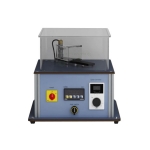
Cam Analysis Apparatus
Product Code : EL-DOMLE-10768
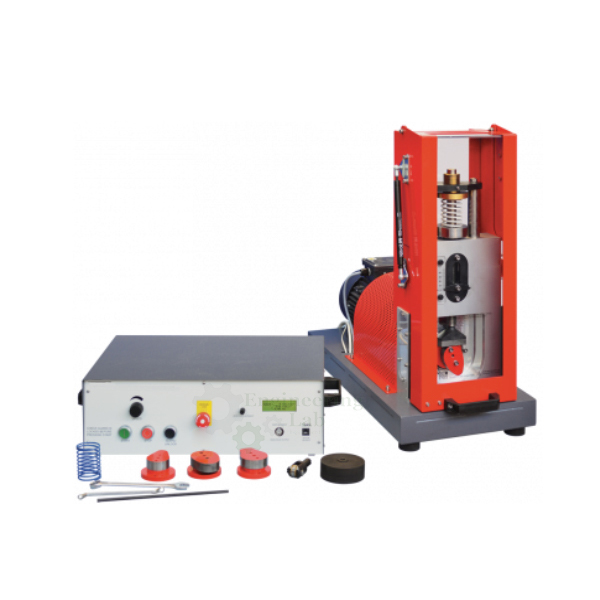
Cam Analysis Apparatus (code EL-DOMLE-10768) is a bench-mounted unit for studying how cams and followers turn rotary motion into linear motion and the speed at which follower bounce begins. A variable-speed, direct-drive motor turns a main shaft with flywheel carrying one of four cams (two convex, one concave, one tangent), on which a roller or flat face follower rides under one of two compression springs and up to five 400 g masses, while sensors measure cam angle and follower lift.
Get a quote: use the Add To Cart enquiry button below, or send your quantity and delivery location through the contact page.
Specifications
| Parameter | Detail |
|---|---|
| Base | Machined heavy steel base holding the motor |
| Motor | High-torque, direct-drive, variable-speed motor, coupled to the main shaft |
| Main shaft | Supported in self-aligning bearings; carries a flywheel that reduces speed variation as torque demand changes through the cam cycle |
| Cam mounting | On the end of the main shaft, located axially and radially for repeatability |
| Cams | 2 convex (of different shape), 1 concave, 1 tangent |
| Followers | 1 roller, 1 flat face; fitted to the bottom of a vertical shaft running in low-friction linear bearings |
| Changeover tool | Included, for changing between the two followers |
| Springs | 2 compression springs with adjustable preload |
| Masses | Five × 400 g, added to alter the force on the cam |
| Sensors | Cam angular position on the main shaft; follower vertical position (displacement or cam lift) on the vertical shaft |
| Terminology | Introduces cam terms such as nose, flank and dwell |
| Experiments | Effect of spring rate, preload and follower mass on bounce speed; measured follower displacement, velocity and acceleration compared with theory; bounce speeds for cam and follower combinations compared with simplified theory |
| Power supply | 230 V, 50/60 Hz, 1 phase; or 120 V, 60 Hz, 1 phase |
| Dimensions | 750 × 500 × 700 mm approx. (L × W × H) |
| Weight | 85 kg |
| Product code | EL-DOMLE-10768 |
| Manufacturer | Engineering Lab Equipment, Ambala, Haryana, India |
What Is the Cam Analysis Apparatus Used For?
A cam and follower convert rotation into a set pattern of lift, and at higher speeds the follower can leave the cam face, or bounce, once the spring and the weight of the moving parts can no longer hold it against the cam. Students fit a cam and a follower, choose a spring and its preload, add masses, and run the motor at rising speeds while the sensors record cam angle and follower lift. Plotting lift against angle and deriving velocity and acceleration, they compare the results with theory and find the speed at which bounce starts for each cam, follower, spring and mass combination.
What to Specify When Ordering
- Quantity — the number of cam apparatus required.
- Power supply — the 230 V, 50/60 Hz or the 120 V, 60 Hz single phase version.
Frequently Asked Questions
Which cams and followers are supplied?
Four cams are supplied, two convex of different shape, one concave and one tangent, together with a roller follower, a flat face follower and a tool for changing followers.
How is follower bounce studied?
Students change spring rate, spring preload and follower mass and increase the speed until the follower begins to bounce, then compare the bounce speeds with those predicted by simplified theory.
What do the sensors measure?
A sensor on the main shaft measures the cam's angular position, and one on the vertical shaft measures the follower's vertical position, its displacement or cam lift.
Why is there a flywheel on the main shaft?
The flywheel reduces speed variations as the torque demand changes during each cam rotation cycle, so the cam turns at a steadier speed while results are recorded.
Which springs and masses come with it?
Two compression springs with adjustable preload and five 400 g masses are included; the masses are added to change the force that pushes the follower onto the cam.
What power supply does it need?
It runs on 230 V, 50/60 Hz, single phase or 120 V, 60 Hz, single phase. The apparatus measures about 750 × 500 × 700 mm and weighs 85 kg.
OEM Manufacturer
Engineering Lab Equipment (Engineering Labs Equipment Pvt Ltd) builds the Cam Analysis Apparatus at its works in Saha, District Ambala, Haryana (Plot No. 43, Industrial Park, Sector 2, Growth Center). Its dynamics of machines apparatus such as governors, gyroscopes, cams and balancing machines go to engineering colleges, polytechnics, technical training institutes and research laboratories in India and abroad, and equipment can be made to an institution's own requirements. For tenders and OEM supply, see the Tenders/OEM page.
Related Dynamics of Machines Equipment
- Computerized Cam Analysis — cam mechanism demonstrator with four cams, two plunger receivers, three return springs and elevation recorder.
- Corollis Component of Acceleration Apparatus — water-jet Coriolis acceleration set-up with rotating tubes, swinging field dynamometer motor and rotameter.
- Digital Corollis Component of Acceleration Apparatus — rotating transparent tank with radial water jet and scale for showing Coriolis deflection.
- Free and Forced Vibration Apparatus — bar-type oscillator trainer with three coil springs, oil damper, two exciters and drum recorder.
See the full Dynamics of Machine Lab Equipment range or all Mechanical Engineering Lab Equipment.
Request a Quote
For this and other dynamics of machine lab equipment, schools and colleges can contact Engineering Lab Equipment, a manufacturer, supplier and exporter based in Ambala, India. For a price, send the number of cam analysis units and the supply voltage required and the delivery location through the contact page; the Add To Cart button on this page also adds the Cam Analysis Apparatus to an enquiry.
Last updated: October 2026