Corollis Component of Acceleration Apparatus
Product Code : EL-DOMLE-10770
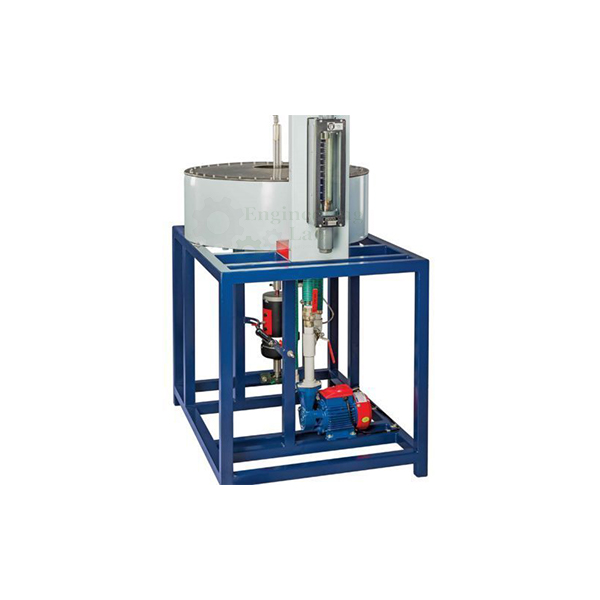
Corollis Component of Acceleration Apparatus (code EL-DOMLE-10770) is an experimental set-up for studying the Coriolis component of acceleration in a slider-crank mechanism, with the mechanical slider replaced by a stream of water flowing through a pair of rotating tubes. A swinging field, variable-speed motor turns the 300 mm long arms and acts as a dynamometer measuring the torque, while a 250 to 2500 LPH rotameter shows the flow. The unit recirculates its own water through a stainless steel tank.
Get a quote: use the Add To Cart enquiry button below, or send your quantity and delivery location through the contact page.
Specifications
| Parameter | Detail |
|---|---|
| Principle | Mechanical slider replaced by a continuous stream of water flowing through a steadily rotating pair of tubes |
| Rotating arms | 9 mm/6 mm orifice diameter, length 300 mm |
| Electric motor | Swinging field, variable speed; acts as a dynamometer continuously measuring the torque on the rotating tubes |
| Flow measurement | Rotameter, 250 to 2500 LPH |
| Pump | FHP pump for water circulation |
| Water tank | Stainless steel, with Perspex window on top for viewing and to prevent splashing |
| Circuit | Self-contained and water-recirculating, with its own speed control unit and pump |
| Frame | Powder-coated structure |
| Experiments | Coriolis component of acceleration at various speeds of rotation and water flow rates |
| Services | Water supply and drain |
| Power supply | 230 V, 50 Hz, 1 phase; 230 V, 60 Hz, 1 phase; or 120 V, 60 Hz, 1 phase |
| Dimensions | 800 × 800 × 1200 mm approx. (L × W × H) |
| Weight | 115 kg |
| Product code | EL-DOMLE-10770 |
| Manufacturer | Engineering Lab Equipment, Ambala, Haryana, India |
What Is the Corollis Component of Acceleration Apparatus Used For?
When a body slides along a link that is itself rotating, as the slider does in some mechanisms, its acceleration has an extra term, the Coriolis component, which is proportional to both the sliding velocity and the angular velocity of the link. In this set-up the water flowing outwards through the rotating tubes takes the place of the slider. Students set the rotation speed and the water flow rate on the rotameter, read the torque from the swinging field motor, and from these values find the Coriolis component of acceleration, repeating the test over a range of rotation speeds and water flow rates.
What to Specify When Ordering
- Quantity — the number of apparatus required.
- Power supply — 230 V 50 Hz, 230 V 60 Hz or 120 V 60 Hz single phase.
Frequently Asked Questions
What does the apparatus demonstrate?
It demonstrates the Coriolis component of acceleration of a slider-crank mechanism, using a continuous stream of water through a rotating pair of tubes in place of a mechanical slider.
How is the torque on the tubes measured?
The tubes are turned by a swinging field electric motor that also acts as a dynamometer, continuously measuring the torque applied to the rotating tubes.
What are the sizes of the rotating arms?
The rotating arms are 300 mm long and have orifice diameters of 9 mm/6 mm, with the water flow through them read on a 250 to 2500 LPH rotameter.
Does it need a separate water circuit?
No. It is self-contained and water-recirculating, with its own speed control unit and water-circulating pump, though a water supply and drain are required.
How can students see the process?
They watch through a Perspex window fitted on top of the stainless steel tank; the window also stops water splashing over the sides of the tank.
What size and weight is the unit?
The set-up measures approximately 800 × 800 × 1200 mm and weighs 115 kg, arranged on a powder-coated structure.
OEM Manufacturer
The Corollis Component of Acceleration Apparatus is made by Engineering Lab Equipment (Engineering Labs Equipment Pvt Ltd) at its works at Plot No. 43, Industrial Park, Sector 2, Growth Center, Saha, District Ambala, Haryana, India. The company designs, makes and tests dynamics of machines apparatus such as governors, gyroscopes, cams and balancing machines for engineering colleges, polytechnics, technical training institutes and research laboratories in India and overseas, and can build equipment to an institution's own requirements. Tender and OEM enquiries are handled through the Tenders/OEM page.
Related Dynamics of Machines Equipment
- Digital Corollis Component of Acceleration Apparatus — rotating transparent tank with radial water jet and scale for showing Coriolis deflection.
- Whirling of Shaft Apparatus — critical speed and shaft whirl demonstrator with six steel shafts, 6000 min-1 motor and Laval disc.
- Universal Vibration Apparatus — profile-frame vibration trainer with beams, springs, imbalance exciter, tunable absorber and two chart recorders.
See the full Dynamics of Machine Lab Equipment range or all Mechanical Engineering Lab Equipment.
Request a Quote
For this and other dynamics of machine lab equipment, schools and colleges can contact Engineering Lab Equipment, a manufacturer, supplier and exporter based in Ambala, India. To ask for a quotation, send the number of apparatus and the supply voltage and frequency and your delivery location through the contact page, or use the Add To Cart enquiry button on this page.
Last updated: October 2026