Flexural Test Devices for Mortar Beams
Product Code : EL-CTLE-10370
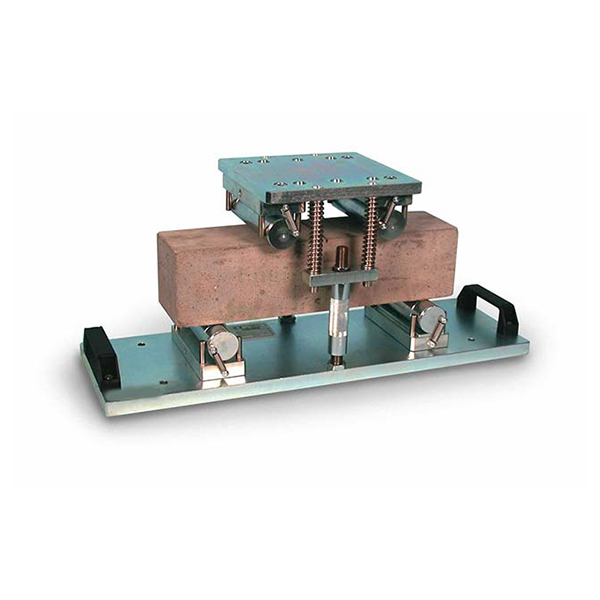
Flexural Test Devices for Mortar Beams (code EL-CTLE-10370) are loading devices used in the cement laboratory for flexural tests on mortar beam specimens. Each has a frame with a spring-supported upper bearer that moves vertically and two lower bearers, one able to tilt, spaced 100 mm for the EN version or 119 mm for the ASTM version; the device stands 188 mm high overall and weighs approximately 8 kg.
Get a quote: use the Add To Cart enquiry button below, or send your quantity and delivery location through the contact page.
Specifications
| Parameter | Detail |
|---|---|
| Use | Flexural tests on mortar beam specimens |
| Frame | With an upper bearer moving vertically, supported by springs |
| Lower bearers | Two; one can tilt horizontally |
| Bearer distance, EN version | 100 mm |
| Bearer distance, ASTM version | 119 mm |
| Versions | EN and ASTM, identical except for the distance between the bearers |
| Total height | 188 mm |
| Weight | Approx. 8 kg |
| Standards | ASTM C348, EN 196-1 |
| Product code | EL-CTLE-10370 |
| Manufacturer | Engineering Lab Equipment, Ambala, Haryana, India |
What Are the Flexural Test Devices for Mortar Beams Used For?
Flexural strength shows how well a hardened mortar resists bending, and it is found on prisms broken under a central load. The device is placed in a testing machine and the mortar beam is laid across the two lower bearers; as the machine closes, the spring-supported upper bearer comes down onto the middle of the beam and loads it until it breaks. One lower bearer can tilt so that the beam is supported evenly even if its faces are not quite parallel. The load at failure gives the flexural strength, and the two broken halves are commonly used afterwards for compressive tests.
What to Specify When Ordering
- Quantity — the number of devices required.
- Version — the EN version with 100 mm bearer distance or the ASTM version with 119 mm.
Frequently Asked Questions
What do the Flexural Test Devices for Mortar Beams do?
They are used to perform flexural tests on mortar beam specimens in the cement testing laboratory, breaking each beam under a load applied through the upper bearer.
How do the EN and ASTM versions differ?
The only difference is the distance between the lower bearers: 100 mm on the EN version and 119 mm on the ASTM version; otherwise the two are identical.
Why can one lower bearer tilt?
A tilting bearer lets the beam settle evenly on both supports, so the load is not concentrated on one edge if the faces of the beam are slightly out of true.
How is the upper bearer mounted?
The upper bearer moves vertically in the frame and is carried on springs, and it transfers the load of the testing machine to the centre of the beam.
What are the height and weight of each device?
The total height of each device is 188 mm and its weight approximately 8 kg; the standards listed are ASTM C348 and EN 196-1.
OEM Manufacturer
Buyers of the Flexural Test Devices for Mortar Beams deal directly with its maker, Engineering Lab Equipment (Engineering Labs Equipment Pvt Ltd), whose works are at Plot No. 43, Industrial Park, Sector 2, Growth Center, Saha, District Ambala, Haryana, India. The company designs, makes and tests cement testing equipment such as Vicat and Blaine apparatus, moulds, mixers and curing equipment, supplies engineering colleges, polytechnics, technical training institutes and research laboratories in India and overseas, and builds to institution-specific requirements on request. Tender details are on the Tenders/OEM page.
Related Cement Testing Equipment
- Heat of Hydration Apparatus — calorimeter set with Dewar flask, Beckman thermometer, constant speed stirrer and Gooch funnel for cement.
- Flow Cone Apparatus — stainless steel flow cone on stand with 1.5 mm sieve, 10 mm nozzle and 1 litre cup.
- Hydraulic Shrinkage Mould — three gang alloy steel mould, HV200 minimum hardness, for cement mortar and grout shrinkage specimens.
- Vicat Needle Apparatus With Dashpot — cement consistency frame with Vicat mould, glass base plate, initial and final needles, plunger and dashpot.
See the full Cement Testing Lab Equipment range or all Civil Engineering Lab Equipment.
Request a Quote
For this and other cement testing lab equipment, schools and colleges can contact Engineering Lab Equipment, a manufacturer, supplier and exporter based in Ambala, India. Quotations are given on request: send the number of devices and whether the EN or ASTM bearer spacing is needed and your delivery location through the contact page, or add the Flexural Test Devices for Mortar Beams to the enquiry cart from this page.
Last updated: October 2026