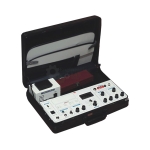
Microprocessor pH Meter
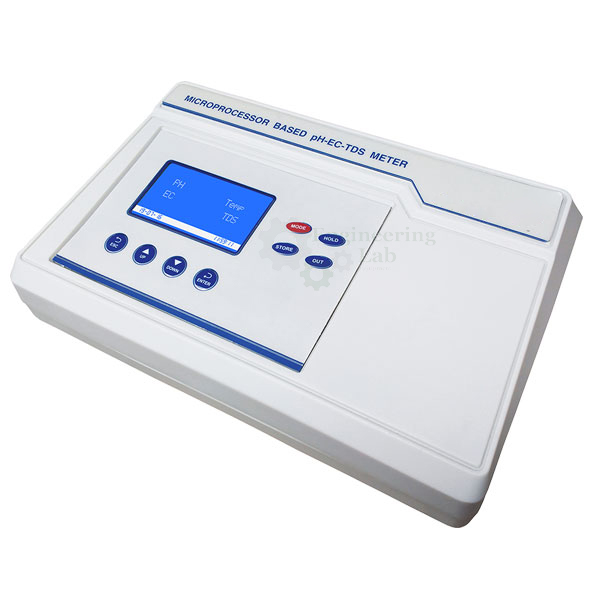
Product Code : EL-ETLE-10965
Microprocessor pH Meter (code EL-ETLE-10965) is a microprocessor-controlled meter that reads pH, millivolts and temperature and shows them on a 16 × 2 alphanumeric LCD. Its pH scale runs from 0 to 14.00 (resolution 0.01, accuracy ±0.01) and its mV scale to ±1999.9 at 0.1 mV; it compensates for temperature from 0 to 100 °C, recognises pH 4.00, 7.00 and 9.20 buffers automatically, offers auto or manual calibration and stores up to 100 samples.
Get a quote: use the Add To Cart enquiry button below, or send your quantity and delivery location through the contact page.
Specifications
| Parameter | Detail |
|---|---|
| Parameters | pH, mV, temperature |
| Display | 16 × 2 alphanumeric LCD |
| pH range | 0 to 14.00 |
| mV range | 0 to ±1999.9 |
| Resolution | 0.01 pH; 0.1 mV; temperature 0.1 °C |
| Accuracy | ±0.01 pH; ±0.1 mV; temperature ±1 °C |
| Temperature compensation | 0 to 100 °C, auto/manual |
| Calibration | Auto/manual |
| Auto buffer recognition | pH 4.00, 7.00, 9.20 |
| Storage | Up to 100 samples |
| Power | 230 V ±10%, 50 Hz AC |
| Product code | EL-ETLE-10965 |
| Manufacturer | Engineering Lab Equipment, Ambala, Haryana, India |
What Is the Microprocessor pH Meter Used For?
In water quality, effluent and soil work the pH of each sample is often logged together with its temperature, since both affect chemical and biological behaviour. This meter recognises the common buffers of pH 4.00, 7.00 and 9.20 by itself, so the user places the electrode in each buffer and lets the meter calibrate automatically, or adjusts it manually, before measuring the samples. Results appear with temperature on the text display, and up to 100 can be stored for recording afterwards. The 0.1 mV resolution on the millivolt range suits redox potential work.
What to Specify When Ordering
- Quantity — the number of pH meters required.
Frequently Asked Questions
Which buffers does the meter recognise automatically?
It recognises pH 4.00, 7.00 and 9.20 buffers automatically, and calibration can be carried out either automatically or manually.
How many readings can be stored?
The memory holds up to 100 samples, so a run of readings can be kept in the meter and written up later.
What are the ranges and resolutions?
pH is read from 0 to 14.00 at 0.01 pH resolution, mV from 0 to ±1999.9 at 0.1 mV, and temperature at 0.1 °C resolution.
What accuracy is quoted?
Accuracy is ±0.01 pH, ±0.1 mV and ±1 °C for temperature, with temperature compensation over 0 to 100 °C.
What kind of display does it have?
Readings appear on a 16 × 2 alphanumeric LCD, which can show text as well as numbers for the measured values.
OEM Manufacturer
The Microprocessor pH Meter is made by Engineering Lab Equipment (Engineering Labs Equipment Pvt Ltd) at its works at Plot No. 43, Industrial Park, Sector 2, Growth Center, Saha, District Ambala, Haryana, India. The company designs, makes and tests environmental testing instruments for water, soil and air analysis for engineering colleges, polytechnics, technical training institutes and research laboratories in India and overseas, and can build equipment to an institution's own requirements. Tender and OEM enquiries are handled through the Tenders/OEM page.
Related Environmental Testing Equipment
- Digital pH Meter — 3.5 digit LED meter for pH 0 to 14.00 and mV 0 to ±1999 with temperature compensation.
- Digital Conductivity Meter — 5-range LED conductivity meter with adjustable cell constant and 0 to 50 °C temperature compensation.
- Digital Turbidity Meter — 0 to 1000 NTU water turbidity meter with tungsten lamp, photodiode detector and 30 mm tubes.
See the full Environmental Testing Lab Equipment range or all Civil Engineering Lab Equipment.
Request a Quote
For this and other environmental testing lab equipment, schools and colleges can contact Engineering Lab Equipment, a manufacturer, supplier and exporter based in Ambala, India. To ask for a quotation, send the number of meters required and your delivery location through the contact page, or use the Add To Cart enquiry button on this page.
Last updated: October 2026