Digital Spectrophotometer
Product Code : EL-ETLE-10971
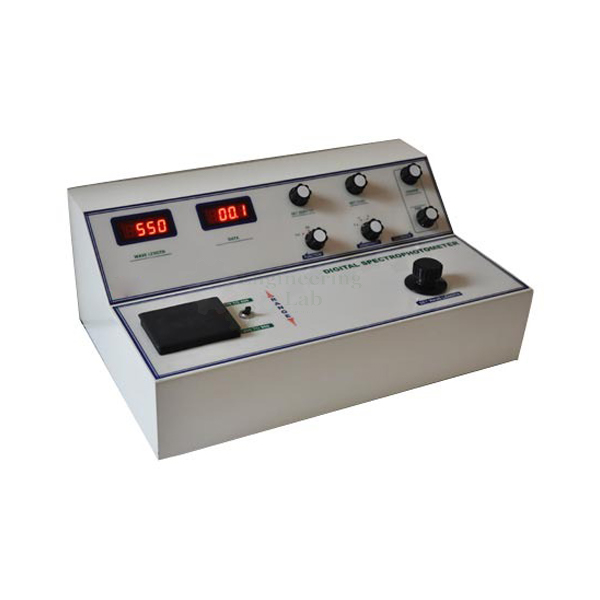
Digital Spectrophotometer (code EL-ETLE-10971) is used to read how much light a liquid sample transmits or absorbs at a selected wavelength between 340 and 960 nm. It uses a 6 V, 1 Amp halogen lamp and a silicon photodiode detector, sets wavelength to 1 nm with ±1 nm repeatability, and reads 0 to 100% T and 0 to 1.999 Abs at 0.1% T and 0.001 Abs resolution on a 3.5 digit LED display.
Get a quote: use the Add To Cart enquiry button below, or send your quantity and delivery location through the contact page.
Specifications
| Parameter | Detail |
|---|---|
| Wavelength range | 340 to 960 nm |
| Wavelength resolution | 1 nm |
| Repeatability | ±1 nm |
| Output | %T 0 to 100%; Abs 0 to 1.999 |
| Resolution | 0.1% T; 0.001 Abs |
| Display | 3.5 digit LED |
| Detector | Silicon photodiode |
| Light source | 6 V, 1 Amp halogen lamp |
| Power | 230 V ±10%, 50 Hz AC |
| Product code | EL-ETLE-10971 |
| Manufacturer | Engineering Lab Equipment, Ambala, Haryana, India |
What Is the Digital Spectrophotometer Used For?
Many water and wastewater tests, such as those for nutrients, metals and other dissolved substances, add a reagent that forms a coloured compound, and the strength of that colour is measured as absorbance, which rises in proportion to concentration over the working range. The operator sets the wavelength at which the coloured compound absorbs most strongly, zeroes the instrument with a blank, then reads the standards and samples in turn and compares their absorbance to find the concentration. Across 340 to 960 nm, the instrument covers the visible region and parts of the near ultraviolet and near infrared.
What to Specify When Ordering
- Quantity — the number of spectrophotometers required.
Frequently Asked Questions
What wavelength range does it cover?
It works from 340 to 960 nm, with a wavelength resolution of 1 nm and a repeatability of ±1 nm.
Which readings does it give?
It reads percent transmittance from 0 to 100% at 0.1% T resolution and absorbance from 0 to 1.999 at 0.001 Abs resolution.
What light source and detector are used?
A 6 V, 1 Amp halogen lamp provides the light, and a silicon photodiode detects what passes through the sample.
How is absorbance related to concentration?
For a coloured solution, absorbance increases in proportion to the concentration of the absorbing substance over the working range, so readings taken on standards allow the concentration in each sample to be calculated.
What is the difference between %T and Abs?
Percent transmittance is the share of light that passes through the sample, while absorbance is a logarithmic scale derived from it that rises with concentration.
OEM Manufacturer
The Digital Spectrophotometer is made by Engineering Lab Equipment (Engineering Labs Equipment Pvt Ltd) at its works at Plot No. 43, Industrial Park, Sector 2, Growth Center, Saha, District Ambala, Haryana, India. The company designs, makes and tests environmental testing instruments for water, soil and air analysis for engineering colleges, polytechnics, technical training institutes and research laboratories in India and overseas, and can build equipment to an institution's own requirements. Tender and OEM enquiries are handled through the Tenders/OEM page.
Related Environmental Testing Equipment
- Microprocessor Photo Colorimeter — 8-filter LED colorimeter for %T, absorbance and concentration over 400 to 700 nm.
- Kjeldahl Digestion Unit — 6-test metal unit for nitrogen digestion with powder coated mild steel housing and lead fume duct.
- COD Digestion Apparatus — 15-tube aluminium block heater to 180 °C with digital controller and 120 minute alarm timer.
See the full Environmental Testing Lab Equipment range or all Civil Engineering Lab Equipment.
Request a Quote
For this and other environmental testing lab equipment, schools and colleges can contact Engineering Lab Equipment, a manufacturer, supplier and exporter based in Ambala, India. To ask for a quotation, send the number of instruments required and your delivery location through the contact page, or use the Add To Cart enquiry button on this page.
Last updated: October 2026