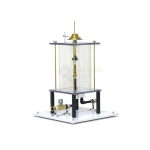
Axial Fan Demonstration Unit

Product Code : EL-FMLE-10647
Axial Fan Demonstration Unit (code EL-FMLE-10647) is a small-scale teaching unit used to demonstrate an axial fan, which produces gas flow parallel to its axis of rotation through momentum changes imparted across its rotary blades. The fan sits between transparent inlet and outlet ducts on a stainless steel base, with an adjustable aperture to vary the airflow and a calibrated orifice plate on the discharge. It gives up to 38 l/s typical flow and 0.06 kPa maximum head at up to 2,700 rpm from a 5 W motor.
Get a quote: use the Add To Cart enquiry button below, or send your quantity and delivery location through the contact page.
Specifications
| Parameter | Detail |
|---|---|
| Type | Small-scale axial fan demonstration unit |
| Operating principle | Gas flow produced by momentum changes imparted across the rotary blades, parallel to the axis of rotation |
| Application range | More suitable for higher flows at lower delivery pressures than a centrifugal fan |
| Main parts | Inlet duct, fan, outlet duct and adjustable aperture |
| Base | Stainless steel plinth |
| Ducts | Transparent air inlet and air outlet ducts, so the fan construction can be seen in operation |
| Airflow adjustment | Manually operated adjustable aperture |
| Flow measurement | Calibrated orifice plate on the discharge |
| Sensors | Electronic sensors for pressure head across the fan, pressure across the orifice plate (and so flow rate), fan rotational speed and air temperature |
| Speed control | Modulated DC supply |
| Power measurement | Current sensing on the DC supply to measure the power drawn by the fan |
| PC connection | USB interface console (an essential accessory); no internal access to the computer needed |
| Data handling | Logging, processing and graphical display of data |
| Software interfacing | Can be interfaced to other software packages |
| Software | Supplied with software giving full instructions for setting up, operating, calibrating and performing the teaching exercises |
| Teaching package | Coursework and laboratory investigation |
| Maximum flow rate | 38 l/s typical |
| Maximum head | 0.06 kPa |
| Maximum fan speed | 2,700 rpm |
| Motor power rating | 5 W |
| Overall size | 850 × 450 × 950 mm (L × W × H) |
| Weight | 90 kg |
| Product code | EL-FMLE-10647 |
| Manufacturer | Engineering Lab Equipment, Ambala, Haryana, India |
What Is the Axial Fan Demonstration Unit Used For?
An axial fan moves air along the line of its shaft, and comparing the head, flow and power it gives at different operating points shows why this type suits large flows at low pressure. Students run the fan from the modulated DC supply and open or close the adjustable aperture to change the airflow, watching the blades through the clear ducts. The sensors pick up the head across the fan, the orifice plate pressure difference that gives the flow rate, the fan speed, the air temperature and the current drawn, and through the USB interface console the readings are logged on a PC and shown as graphs.
What to Specify When Ordering
- Quantity — the number of fan units required.
- USB interface console — the console used to link the unit to a PC, listed as an essential accessory.
Frequently Asked Questions
What does the unit show about axial fans?
It shows how an axial fan produces gas flow parallel to its axis of rotation through momentum changes across the rotary blades, a type more suited to higher flows at lower delivery pressures than a centrifugal fan.
How is the airflow rate varied and measured?
A manually operated adjustable aperture varies the airflow, and a calibrated orifice plate on the discharge measures it; an electronic sensor reads the pressure across the plate to give the flow rate.
Which quantities do the sensors record?
Electronic sensors measure the pressure head developed across the fan, the pressure across the orifice plate, the rotational speed of the fan and the air temperature, while current sensing gives the power drawn.
What are the performance limits?
The maximum flow rate is 38 l/s typical, the maximum head is 0.06 kPa and the maximum fan speed is 2,700 rpm, with a motor power rating of 5 W.
Can the unit be connected to a computer?
Yes. It links to a PC through a USB interface console, an essential accessory that needs no internal access to the computer. The software logs, processes and plots the data and can interface with other packages.
How large and heavy is it?
The unit measures 850 × 450 × 950 mm (L × W × H) and weighs 90 kg, with the fan and ducts mounted on a stainless steel plinth.
OEM Manufacturer
The Axial Fan Demonstration Unit is made by Engineering Lab Equipment (Engineering Labs Equipment Pvt Ltd) at its works at Plot No. 43, Industrial Park, Sector 2, Growth Center, Saha, District Ambala, Haryana, India. The company designs, makes and tests fluid mechanics apparatus for flow measurement, pipe friction, pumps and hydrostatics for engineering colleges, polytechnics, technical training institutes and research laboratories in India and overseas, and can build equipment to an institution's own requirements. Tender and OEM enquiries are handled through the Tenders/OEM page.
Related Fluid Mechanics Equipment
- Bernoulli Theorem Demonstration Module — clear acrylic Venturi module with Pitot probe and eight-tube manometer for verifying Bernoulli's theorem.
- Cavitation Demonstration Apparatus — clear acrylic Venturi test section with three Bourdon gauges for observing cavitation and air release.
- Centrifugal Fan Demonstration Unit — radial fan rig with forward and backward curved rotors, intake nozzle flow measurement and USB data link.
See the full Fluid Mechanics Lab Equipment range or all Mechanical Engineering Lab Equipment.
Request a Quote
For this and other fluid mechanics lab equipment, schools and colleges can contact Engineering Lab Equipment, a manufacturer, supplier and exporter based in Ambala, India. To ask for a quotation, send the number of fan units and whether the USB interface console is needed and your delivery location through the contact page, or use the Add To Cart enquiry button on this page.
Last updated: October 2026