Centrifugal Fan Demonstration Unit
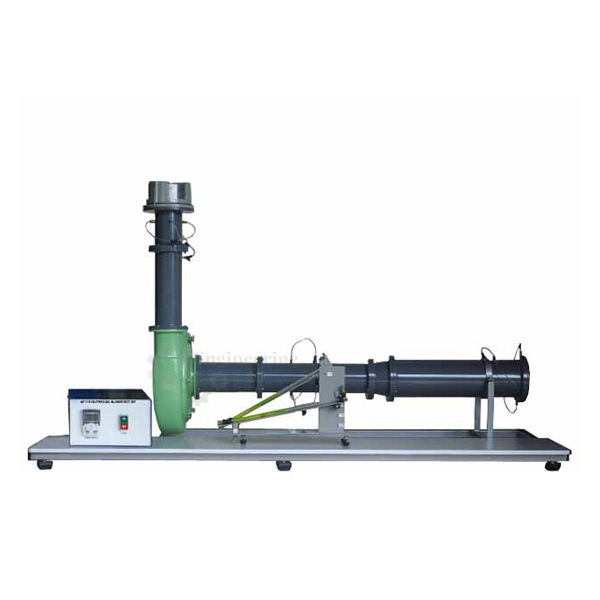
Product Code : EL-FMLE-10651
Centrifugal Fan Demonstration Unit (code EL-FMLE-10651) is an experimental set-up for learning the operating behaviour and main characteristic variables of a radial fan, which draws gas in along its drive shaft and turns it through 90° to discharge it radially. A 110 W fan with a 3-phase AC motor and frequency converter runs at a nominal 2800 min-1, giving up to 480 m³/h and 300 Pa, and two interchangeable rotors with forward and backward curved blades are supplied.
Get a quote: use the Add To Cart enquiry button below, or send your quantity and delivery location through the contact page.
Specifications
| Parameter | Detail |
|---|---|
| Use | Studying the operating behaviour and characteristic variables of radial fans |
| Operating principle | Medium drawn in axially to the drive shaft, deflected by 90° by the rotating rotor and discharged radially |
| Fan application | Radial fans transport gases with non-excessive pressure differences |
| Fan drive | Radial fan with 3-phase AC motor |
| Speed control | Variable speed via frequency converter |
| Rotors supplied | Two interchangeable rotors: one with forward curved blades and one with backward curved blades |
| Pipes | Transparent intake and delivery pipes |
| Flow adjustment | Throttle valve in the delivery pipe |
| Flow measurement | Differential pressure measurement on the intake nozzle |
| Sensors | Pressure and temperature |
| Displayed values | Differential pressure, flow rate, speed, electrical power consumption, hydraulic power output, temperature and efficiency |
| Measuring electronics | Microprocessor-based, protected inside the housing |
| PC connection | USB, with software included for display and evaluation of the measured values and for operating the unit |
| Intake pipe | |
| Inner diameter | 90 mm |
| Length | 430 mm |
| Delivery pipe | |
| Inner diameter | 100 mm |
| Length | 530 mm |
| Measuring ranges | |
| Differential pressure | 0 to 1800 Pa |
| Flow rate | 0 to 1000 m³/h |
| Temperature | 0 to 100 °C |
| Speed | 0 to 3300 min-1 |
| Electrical power consumption | 0 to 250 W |
| Radial fan | |
| Power consumption | 110 W |
| Nominal speed | 2800 min-1 |
| Maximum volumetric flow rate | 480 m³/h |
| Maximum pressure difference | 300 Pa |
| Power supply, size and weight | |
| Power required | 230 V, 50 Hz, 1 phase |
| L × W × H | 950 × 450 × 900 mm |
| Weight | 90 kg |
| Supply | |
| Product code | EL-FMLE-10651 |
| Manufacturer | Engineering Lab Equipment, Ambala, Haryana, India |
What Is the Centrifugal Fan Demonstration Unit Used For?
Radial, or centrifugal, fans move gases against moderate pressure differences, and their performance is described by curves of pressure rise, power and efficiency plotted against flow rate. Students set the fan speed on the frequency converter and close the throttle valve in steps, while the software records the differential pressure, the flow from the intake nozzle, speed, temperature and electrical power at each point and works out hydraulic power and efficiency. Exchanging the forward curved rotor for the backward curved one and repeating the run shows how blade shape changes the fan characteristic.
What to Specify When Ordering
- Quantity — the number of fan units required.
Frequently Asked Questions
How does a radial fan move the gas?
Gas enters axially along the drive shaft, the spinning rotor deflects it by 90°, and it leaves radially. Radial fans are used to transport gases with non-excessive pressure differences.
Which rotors come with the unit?
Two rotors are included in the scope of delivery, one with forward curved blades and one with backward curved blades, and they can be interchanged to compare the two blade shapes.
What do the measuring ranges cover?
Differential pressure reads 0 to 1800 Pa, flow rate 0 to 1000 m³/h, temperature 0 to 100 °C, speed 0 to 3300 min-1 and electrical power consumption 0 to 250 W.
What is the rating of the fan itself?
The radial fan draws 110 W, has a nominal speed of 2800 min-1 and delivers a maximum volumetric flow rate of 480 m³/h at up to 300 Pa pressure difference.
How is the flow rate found?
Flow rate is determined from a differential pressure measurement on the intake nozzle, and the value goes with the other readings to a PC over USB for analysis in the software supplied.
How can this fan unit be ordered?
Click the Add To Cart enquiry button on this page, or use the contact page to give the number of units needed and where they are to be delivered.
OEM Manufacturer
Engineering Lab Equipment (Engineering Labs Equipment Pvt Ltd) builds the Centrifugal Fan Demonstration Unit at its works in Saha, District Ambala, Haryana (Plot No. 43, Industrial Park, Sector 2, Growth Center). Its fluid mechanics apparatus for flow measurement, pipe friction, pumps and hydrostatics go to engineering colleges, polytechnics, technical training institutes and research laboratories in India and abroad, and equipment can be made to an institution's own requirements. For tenders and OEM supply, see the Tenders/OEM page.
Related Fluid Mechanics Equipment
- Axial Fan Demonstration Unit — teaching unit for axial fan studies with clear ducts, orifice plate flow measurement and 38 l/s typical flow.
- Subsonic Wind Tunnel — bench-top subsonic tunnel with 150 mm square clear working section and air speeds up to 34 m/s.
- Compressible Flow Unit — variable-speed radial fan unit with transparent nozzles, pipe sections and orifice for subsonic and transonic air flow.
- Flow Meter Demonstration Unit — transparent Venturi, orifice plate and variable area meter set with 8-tube manometer for bench flow studies.
See the full Fluid Mechanics Lab Equipment range or all Mechanical Engineering Lab Equipment.
Request a Quote
For this and other fluid mechanics lab equipment, schools and colleges can contact Engineering Lab Equipment, a manufacturer, supplier and exporter based in Ambala, India. For a price, send the number of fan units required and the delivery location through the contact page; the Add To Cart button on this page also adds the Centrifugal Fan Demonstration Unit to an enquiry.
Last updated: October 2026