Propeller Turbine
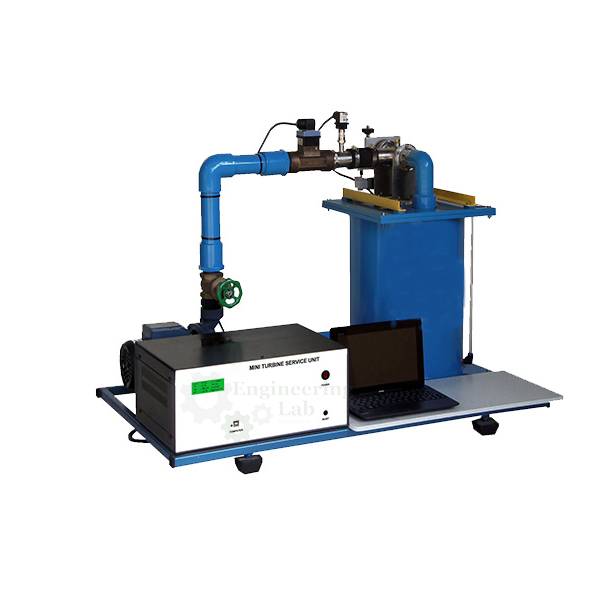
Product Code : EL-FMLE-10679
Propeller Turbine (code EL-FMLE-10679) is a self-contained, small-scale hydropower unit that demonstrates an inward flow reaction turbine similar to a Kaplan design but with fixed blades, a type most suited to high flow rates. A 75 l reservoir and circulating pump (14 m head at 4.4 l/s) feed the propeller through adjustable guide vanes, and a PC-controlled magnetic brake with load cell and optical speed sensor loads it up to 55 W, 0.60 Nm and 3,500 rpm.
Get a quote: use the Add To Cart enquiry button below, or send your quantity and delivery location through the contact page.
Specifications
| Parameter | Detail |
|---|---|
| Unit type | Self-contained, small-scale hydropower unit |
| Turbine type | Inward flow reaction turbine, similar to a Kaplan design but with fixed blades |
| Runner | Propeller, housed in a clear acrylic pipe |
| Guide vanes | Adjustable; control the water flow and direct it at an angle onto the back of the propeller |
| Viewing | Clear viewing window around the guide vanes and clear draft tube |
| Base | Framework base housing the water reservoir and circulating pump; stainless steel top supporting the turbine and dynamometer assembly |
| Water reservoir | 75 l |
| Circulating pump | 14 m head at 4.4 l/s |
| Loading | Magnetic brake unit controlled directly from a PC via a USB interface |
| Sensors | Load cell for braking force (and so power); optical sensor for rotational speed; electronic sensors for process variables |
| Software | Education software package with results processing and help facilities; data export to Microsoft Excel or other spreadsheet software |
| Experiments | Volume flow rate, head, torque, power output and efficiency against rotational speed |
| Maximum power | 55 W |
| Maximum torque | 0.60 Nm |
| Maximum speed | 3,500 rpm |
| Power required | 230 V, 1 phase |
| Dimensions and weight | |
| L × W × H | 1000 × 800 × 1200 mm |
| Weight | 120 kg |
| Supply | |
| Product code | EL-FMLE-10679 |
| Manufacturer | Engineering Lab Equipment, Ambala, Haryana, India |
What Is the Propeller Turbine Used For?
In a propeller turbine the water passes through a runner shaped like a ship's propeller, and because the blades are fixed the guide vanes are the only means of matching the turbine to the flow. Students set the guide vane angle, run the circulating pump and apply the magnetic brake in steps from the PC, while the load cell and optical sensor record braking force and speed. The software combines these with flow and head so that torque, power output and efficiency can be plotted against rotational speed, and watching the runner through the clear draft tube shows how the vane setting changes the flow pattern.
What to Specify When Ordering
- Quantity — the number of turbine units required.
Frequently Asked Questions
How does a propeller turbine differ from a Kaplan turbine?
It is an inward flow reaction turbine similar to a Kaplan design, but its propeller blades are fixed. It is a very common turbine type and is most suited to high flow rates.
What controls the flow onto the propeller?
Adjustable guide vanes control the water flow in the turbine and direct it at an angle onto the back of the propeller, and a clear window around them shows their effect.
How is the turbine loaded and measured?
A magnetic brake unit controlled from a PC through a USB interface loads the turbine, a load cell measures the braking force and an optical sensor measures the rotational speed.
What are the maximum ratings?
The turbine has a maximum power of 55 W, a maximum torque of 0.60 Nm and a maximum speed of 3,500 rpm, and the unit needs 230 V, 1 phase power.
Does it need an external water supply?
No. It is self-contained: the framework base holds a 75 l water reservoir and a circulating pump that produces 14 m head at 4.4 l/s.
Can the results be exported?
Yes. The education software processes the results and can export the data to Microsoft Excel or other spreadsheet software for further analysis.
OEM Manufacturer
Buyers of the Propeller Turbine deal directly with its maker, Engineering Lab Equipment (Engineering Labs Equipment Pvt Ltd), whose works are at Plot No. 43, Industrial Park, Sector 2, Growth Center, Saha, District Ambala, Haryana, India. The company designs, makes and tests fluid mechanics apparatus for flow measurement, pipe friction, pumps and hydrostatics, supplies engineering colleges, polytechnics, technical training institutes and research laboratories in India and overseas, and builds to institution-specific requirements on request. Tender details are on the Tenders/OEM page.
Related Fluid Mechanics Equipment
- Demonstration Francis Turbine — reaction turbine model of the Francis type with 7 adjustable guide vanes, 11-blade rotor and band brake.
- Demonstration Pelton Turbine — impulse turbine model with 10 mm needle nozzle, 14-blade wheel, band brake and transparent front panel.
- Axial Fan Demonstration Unit — teaching unit for axial fan studies with clear ducts, orifice plate flow measurement and 38 l/s typical flow.
- Energy Losses in Pipes — ten-section pipe friction trainer with copper, steel and PVC pipes, bends, valves and differential pressure meter.
See the full Fluid Mechanics Lab Equipment range or all Mechanical Engineering Lab Equipment.
Request a Quote
For this and other fluid mechanics lab equipment, schools and colleges can contact Engineering Lab Equipment, a manufacturer, supplier and exporter based in Ambala, India. Quotations are given on request: send the number of propeller turbine units required and your delivery location through the contact page, or add the Propeller Turbine to the enquiry cart from this page.
Last updated: October 2026