Cavitation Demonstration Apparatus

Product Code : EL-FMLE-10650
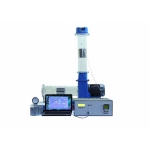
Cavitation Demonstration Apparatus (code EL-FMLE-10650) is a self-contained unit used to show how cavitation forms and how it affects the performance of hydraulic machines and systems. Water passes through a clear acrylic, circular Venturi-shaped test section between upstream and downstream flow control valves, and three Bourdon gauges read the pressure before the contraction, in the throat (100 mm vacuum gauge, -1 to 0 bar) and after the expansion (63 mm gauges).
Get a quote: use the Add To Cart enquiry button below, or send your quantity and delivery location through the contact page.
Specifications
| Parameter | Detail |
|---|---|
| Use | Demonstrating and observing cavitation and its effect on the performance of hydraulic machines and systems |
| Type | Self-contained apparatus |
| Test section | Circular Venturi-shaped section of clear acrylic, giving a full view of cavitation inside |
| Pressure indication | Three Bourdon gauges: upstream of the contraction, inside the throat and downstream of the expansion |
| Flow control | Flow control valves upstream and downstream of the test section for adjusting flow and pressure |
| Connection | Quick-release fitting for connection to the Hydraulics Bench |
| Pump | Includes electrical protection |
| Water tank | Splash cover to prevent water spillage |
| Demonstrations | Cavitation by reducing the liquid to its vapour pressure; air release from dissolved gases; reduction of cavitation by raising the static pressure; theoretical and actual pressure at cavitation conditions compared |
| Software | Educational software available as an option |
| Upstream pressure gauge | |
| Diameter | 63 mm |
| Range | 0 to 1 bar |
| Throat vacuum gauge | |
| Diameter | 100 mm |
| Range | -1 to 0 bar |
| Downstream pressure gauge | |
| Diameter | 63 mm |
| Range | 0 to -1 bar |
| Dimensions and weight | |
| L × W × H | 500 × 350 × 400 mm |
| Weight | 30 kg |
| Supply | |
| Product code | EL-FMLE-10650 |
| Manufacturer | Engineering Lab Equipment, Ambala, Haryana, India |
What Is the Cavitation Demonstration Apparatus Used For?
Cavitation happens when the local pressure in a flowing liquid drops to its vapour pressure: vapour bubbles form in the low-pressure zone and then collapse violently when the pressure recovers, which in pumps and turbines causes noise, loss of output and surface damage. The student opens the flow control valves to raise the velocity through the throat until bubbles appear, notes the three gauge readings and compares the measured throat pressure with the theoretical value. Raising the static pressure in the section with the valves shows cavitation being suppressed, and the release of dissolved air can be watched as a separate effect.
What to Specify When Ordering
- Quantity — the number of cavitation units required.
- Software — whether the optional educational software is to be supplied with the unit.
Frequently Asked Questions
What causes the bubbles seen in the test section?
As flow through the throat increases, its pressure falls in line with the Bernoulli equation until it reaches the vapour pressure of the water; vapour bubbles then form and collapse violently as the pressure rises again downstream.
Which pressure gauges are fitted and what do they read?
Three Bourdon gauges are fitted. The upstream gauge is 63 mm with a 0 to 1 bar range, the throat vacuum gauge is 100 mm reading -1 to 0 bar, and the downstream gauge is 63 mm reading 0 to -1 bar.
How are the test conditions adjusted?
Flow control valves upstream and downstream of the test section change the flow and pressure, so conditions can be set first for the onset of cavitation and then for suppressing it.
Which demonstrations can be carried out?
Students can observe cavitation, see air released from dissolved gases, show that a higher static pressure reduces cavitation and compare theoretical with actual pressure at cavitation conditions.
Does it work with a Hydraulics Bench?
It has a quick-release fitting for connection to a Hydraulics Bench. The pump has electrical protection and the water tank carries a splash cover to prevent spillage.
What are its size and weight?
Overall, the apparatus measures 500 × 350 × 400 mm (L × W × H), and its weight is 30 kg.
OEM Manufacturer
The Cavitation Demonstration Apparatus is made by Engineering Lab Equipment (Engineering Labs Equipment Pvt Ltd) at its works at Plot No. 43, Industrial Park, Sector 2, Growth Center, Saha, District Ambala, Haryana, India. The company designs, makes and tests fluid mechanics apparatus for flow measurement, pipe friction, pumps and hydrostatics for engineering colleges, polytechnics, technical training institutes and research laboratories in India and overseas, and can build equipment to an institution's own requirements. Tender and OEM enquiries are handled through the Tenders/OEM page.
Related Fluid Mechanics Equipment
- Osborne Reynolds Demonstration — dye-injection pipe flow apparatus with 16 mm transparent test pipe for laminar, transition and turbulent flow.
- Impact of a Jet Apparatus — water jet rig with 8 mm nozzle, flat, 120° curved and hemispherical targets and weight-loaded balance.
- Pipe Surge and Water Hammer Apparatus — two 3 m stainless steel test pipes with surge shaft, fast acting valve and pressure sensors.
See the full Fluid Mechanics Lab Equipment range or all Mechanical Engineering Lab Equipment.
Request a Quote
For this and other fluid mechanics lab equipment, schools and colleges can contact Engineering Lab Equipment, a manufacturer, supplier and exporter based in Ambala, India. To ask for a quotation, send the number of cavitation units and whether educational software is wanted and your delivery location through the contact page, or use the Add To Cart enquiry button on this page.
Last updated: October 2026