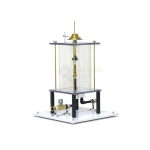
Gear Pump Demonstration Unit
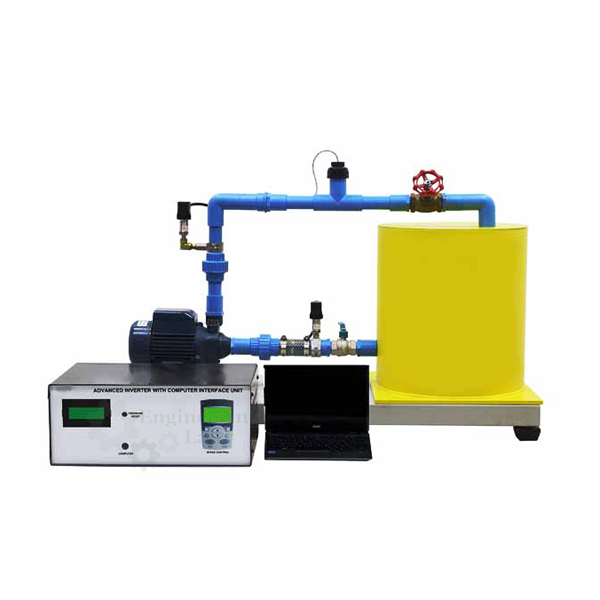
Product Code : EL-FMLE-10663
Gear Pump Demonstration Unit (code EL-FMLE-10663) is a small-scale rig for teaching pump performance, built around a motor-driven gear pump, the positive displacement rotary pump in which two meshing gear wheels carry liquid round between their teeth. It circulates water from a clear acrylic reservoir through a clear acrylic pump head, control valve and relief valve on a stainless steel base, with inverter speed control, a 250 W motor, up to 25 m head, 6.5 l/m typical flow and 1,800 rpm maximum pump speed.
Get a quote: use the Add To Cart enquiry button below, or send your quantity and delivery location through the contact page.
Specifications
| Parameter | Detail |
|---|---|
| Pump type | Motor-driven gear pump (positive displacement rotary pump, no valves) |
| Operating principle | Two gear wheels in a casing, one driven and the other rotating in mesh with it; liquid carried between consecutive teeth and ejected as the teeth mesh |
| Pump characteristics | Delivers against high pressures; more even output than a reciprocating pump; suitable for high-viscosity fluids |
| Main parts | Water reservoir, pump, control valve, relief valve and interconnecting pipework |
| Base | Stainless steel plinth; pipework for continuous circulation |
| Transparent parts | Pump head and water reservoir of clear acrylic |
| Speed control | Electronic inverter, which also calculates the torque at the motor drive shaft so the power used can be derived |
| Sensors | Electronic sensors for pump head pressure, flow rate and water temperature, with conditioning electronics for display in the software |
| PC connection | Can be linked to a PC; logging, processing and graphical display of data |
| Software | Supplied with software giving full instructions for setting up, operating, calibrating and performing the teaching exercises |
| Teaching package | Coursework and laboratory investigation |
| Experiments | Constant-speed pump performance: characteristic curves of outlet pressure against flow rate, motor shaft power, pump speed, pump efficiency and volumetric efficiency; comparison of student calculations with computer results |
| Maximum flow rate | 6.5 l/m typical |
| Motor power rating | 250 W, 230 V, 1 phase |
| Maximum head | 25 m |
| Maximum pump speed | 1,800 rpm |
| Dimensions and weight | |
| L × W × H | 800 × 600 × 800 mm |
| Weight | 90 kg |
| Supply | |
| Product code | EL-FMLE-10663 |
| Manufacturer | Engineering Lab Equipment, Ambala, Haryana, India |
What Is the Gear Pump Demonstration Unit Used For?
A gear pump displaces a fixed volume of liquid on each revolution, so its delivery depends mainly on speed rather than on the pressure it works against, the opposite of a centrifugal pump. Students run the pump at a set inverter speed, close the control valve in steps to raise the outlet pressure, and log head pressure, flow rate, water temperature and the shaft torque from the inverter at each step. The software turns these into curves of outlet pressure against flow, shaft power, speed, pump efficiency and volumetric efficiency, which students check against their own calculations, while the relief valve guards against excess pressure.
What to Specify When Ordering
- Quantity — the number of gear pump units required.
Frequently Asked Questions
How does a gear pump work?
Two gear wheels turn in a casing, one driven and the other in mesh with it. Liquid is carried round in the spaces between consecutive teeth and pushed out as the teeth mesh, without any valves.
Why is a gear pump chosen for viscous fluids?
As a positive displacement pump it delivers against high pressures and gives a more even flow than a reciprocating pump, which makes it particularly suitable for high-viscosity fluids.
What does the unit measure?
Electronic sensors read pump head pressure, flow rate and water temperature, and the electronic inverter calculates the torque at the motor drive shaft so that the power used by the pump can be derived.
What are the performance figures?
Maximum flow rate is 6.5 l/m typical, maximum head is 25 m and maximum pump speed is 1,800 rpm, from a 250 W, 230 V single-phase motor.
Which characteristic curves can students produce?
At constant speed, outlet pressure is plotted against flow rate, motor shaft power, pump speed, pump efficiency and volumetric efficiency, and the results are compared with the students' own calculations.
Can the pumping action be seen?
Yes. The pump head and the water reservoir are both made of clear acrylic, so the gears and the circulating water are visible while the pump runs.
OEM Manufacturer
Engineering Lab Equipment (Engineering Labs Equipment Pvt Ltd) builds the Gear Pump Demonstration Unit at its works in Saha, District Ambala, Haryana (Plot No. 43, Industrial Park, Sector 2, Growth Center). Its fluid mechanics apparatus for flow measurement, pipe friction, pumps and hydrostatics go to engineering colleges, polytechnics, technical training institutes and research laboratories in India and abroad, and equipment can be made to an institution's own requirements. For tenders and OEM supply, see the Tenders/OEM page.
Related Fluid Mechanics Equipment
- Plunger Pump Demonstration Unit — reciprocating plunger pump rig with pulsation damper, sprung and needle loading valves and cylinder pressure sensing.
- Series Parallel Pumps — two centrifugal pumps in a closed circuit with valves for single, series and parallel operation.
- Free and Forced Vortex Apparatus — transparent 250 mm vortex vessel with angled inlet tubes, paddle, push-in orifices and profile gauge.
See the full Fluid Mechanics Lab Equipment range or all Mechanical Engineering Lab Equipment.
Request a Quote
For this and other fluid mechanics lab equipment, schools and colleges can contact Engineering Lab Equipment, a manufacturer, supplier and exporter based in Ambala, India. For a price, send the number of gear pump units required and the delivery location through the contact page; the Add To Cart button on this page also adds the Gear Pump Demonstration Unit to an enquiry.
Last updated: October 2026