Pipe Surge and Water Hammer Apparatus
Product Code : EL-FMLE-10675
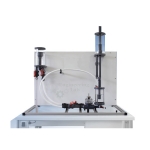
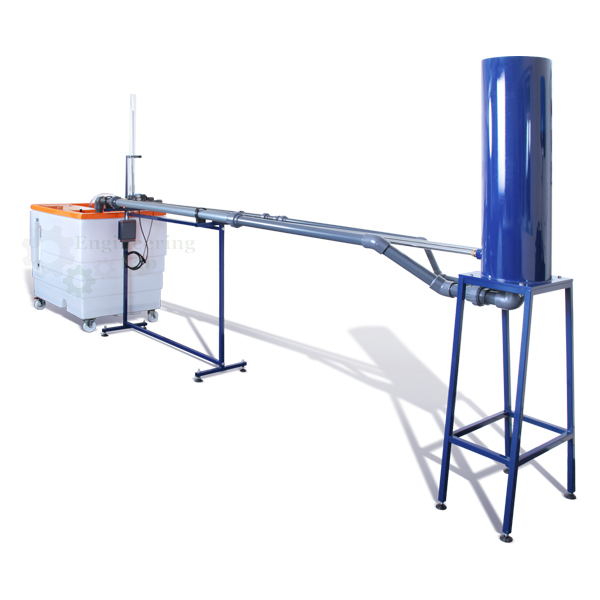
Pipe Surge and Water Hammer Apparatus (code EL-FMLE-10675) is a freestanding unit used to demonstrate pipe surge from slow deceleration of flow and water hammer from rapid deceleration, and to determine the speed of sound in water in an elastic pipe. Two 3 m stainless steel test pipes of 20.2 mm bore run from a 45 litre PVC constant head tank: one has a lever-operated valve and a clear acrylic surge shaft 40 mm in bore and 800 mm high, the other a trigger-actuated fast acting valve with electronic pressure sensors.
Get a quote: use the Add To Cart enquiry button below, or send your quantity and delivery location through the contact page.
Specifications
| Parameter | Detail |
|---|---|
| Use | Demonstrating pipe surge and water hammer; determining the velocity of sound through a fluid in an elastic pipe |
| Type | Freestanding, with connections to a Hydraulics Bench |
| Head tank | PVC constant head tank, capacity 45 liters |
| Test pipes | Two, stainless steel, 20.2 mm inside diameter, 3 m long |
| Pipe surge test pipe | |
| Surge shaft | Transparent, clear acrylic, 40 mm inside diameter, 800 mm high, with a scale for low-speed water-level transients |
| Discharge valve | Lever operated valve at the discharge end |
| Flow setting | Additional downstream valve to vary the flow before the lever operated valve is closed |
| Water hammer test pipe | |
| Discharge valve | Fast acting valve with trigger actuator, giving an extremely short closure time |
| Flow setting | Additional downstream valve to vary the flow before the fast acting valve is closed |
| Pressure sensors | Electronic sensors in tappings next to the fast acting valve and half way along the pipe, measuring high-speed pressure transients |
| Speed of sound | Determined from the time delay between the two sensors |
| Experiments | |
| Pipe surge | Surge from slow deceleration of flow; oscillatory characteristics of a surge; shaft used to attenuate surge |
| Water hammer | Pressure profile from rapid deceleration of flow; theoretical and measured pressure profiles compared; velocity of sound in an elastic pipe |
| Dimensions and weight | |
| L × W × H | 3500 × 800 × 1600 mm |
| Weight | 120 kg |
| Supply | |
| Product code | EL-FMLE-10675 |
| Manufacturer | Engineering Lab Equipment, Ambala, Haryana, India |
What Is the Pipe Surge and Water Hammer Apparatus Used For?
Closing a valve on a moving column of water converts its momentum into pressure: closed slowly, the result is a surge that a surge shaft absorbs as a rise and fall in water level, while closed almost instantly it creates water hammer, a pressure wave that travels to and fro along the pipe at the speed of sound in the water and pipe wall. Students set a flow with the downstream valve, close the lever valve and read the oscillating level on the surge shaft scale, then trip the fast acting valve and record the pressure spikes at both sensors. The time delay between the sensors gives the wave speed for comparison with theory.
What to Specify When Ordering
- Quantity — the number of surge and water hammer units required.
Frequently Asked Questions
What is the difference between pipe surge and water hammer?
Pipe surge results from slow deceleration of flow in a pipe and shows as a slow change in water level, while water hammer results from rapid deceleration and produces high-speed pressure transients.
How is water hammer produced in such a short pipe?
The second test pipe ends in a fast acting valve released by a trigger actuator. Its extremely short closure time lets water hammer form in a relatively short length of straight pipe.
How is the speed of sound found?
Electronic pressure sensors next to the fast acting valve and half way along the pipe record the pressure wave, and the time delay between them gives the speed of sound in the water as affected by the pipe wall.
What is the surge shaft for?
The clear acrylic surge shaft, 40 mm in bore and 800 mm high, attenuates the surge, and its scale lets the low-speed changes in water level be read.
What are the test pipe dimensions?
Both test pipes are stainless steel with a 20.2 mm inside diameter and a length of 3 m, fed from a PVC head tank of 45 liters capacity.
How much floor space does it need?
The freestanding apparatus measures 3500 × 800 × 1600 mm (L × W × H) and weighs 120 kg, and it connects to a Hydraulics Bench.
OEM Manufacturer
Engineering Lab Equipment (Engineering Labs Equipment Pvt Ltd) builds the Pipe Surge and Water Hammer Apparatus at its works in Saha, District Ambala, Haryana (Plot No. 43, Industrial Park, Sector 2, Growth Center). Its fluid mechanics apparatus for flow measurement, pipe friction, pumps and hydrostatics go to engineering colleges, polytechnics, technical training institutes and research laboratories in India and abroad, and equipment can be made to an institution's own requirements. For tenders and OEM supply, see the Tenders/OEM page.
Related Fluid Mechanics Equipment
- Hydraulic Ram Test Bed — water hammer ram pump rig with acrylic body, stainless steel valves, air vessel and adjustable header tank.
- Impact of a Jet Apparatus — water jet rig with 8 mm nozzle, flat, 120° curved and hemispherical targets and weight-loaded balance.
- Energy Losses in Pipes — ten-section pipe friction trainer with copper, steel and PVC pipes, bends, valves and differential pressure meter.
- Pipe Network Apparatus — freestanding PVC pipe network with isolating valves, 6 to 14 mm pipes and digital pressure meter.
See the full Fluid Mechanics Lab Equipment range or all Mechanical Engineering Lab Equipment.
Request a Quote
For this and other fluid mechanics lab equipment, schools and colleges can contact Engineering Lab Equipment, a manufacturer, supplier and exporter based in Ambala, India. For a price, send the number of surge and water hammer units required and the delivery location through the contact page; the Add To Cart button on this page also adds the Pipe Surge and Water Hammer Apparatus to an enquiry.
Last updated: October 2026