Orifice and Mouth Piece Flow Apparatus
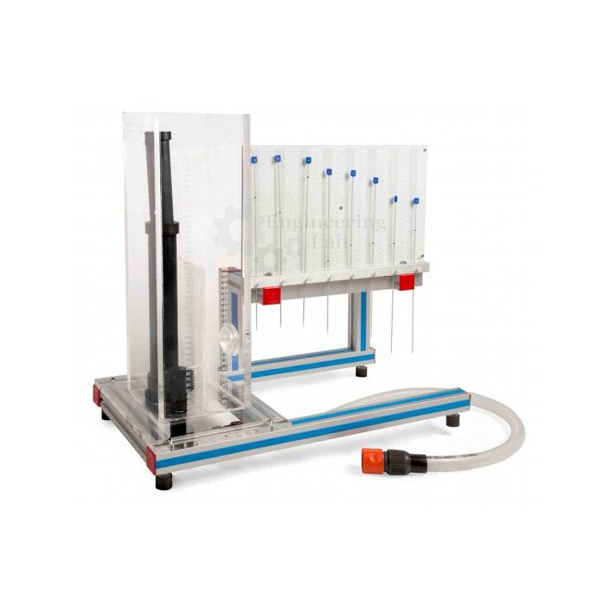
Product Code : EL-FMLE-10669
Orifice and Mouth Piece Flow Apparatus (code EL-FMLE-10669) is used to find the discharge, velocity and contraction coefficients of an orifice and a mouthpiece and to trace the trajectory of the jet they produce. A cylindrical clear methacrylate tank, kept at constant level from the Basic Hydraulic Feed System or Hydraulics Bench, takes interchangeable 3.5 mm and 6 mm orifices in its base, with a traversing Pitot tube and fine wire for the jet and vena contracta diameters and 8 trajectory probes up to 500 mm height.
Get a quote: use the Add To Cart enquiry button below, or send your quantity and delivery location through the contact page.
Specifications
| Parameter | Detail |
|---|---|
| Use | Determining the coefficient of discharge, velocity coefficient and contraction coefficient of an orifice and a mouthpiece; tracing the trajectory and profile of the jet |
| Tank | Cylindrical clear acrylic (methacrylate) tank maintaining a constant water level, with the orifice fitted in the base |
| Water supply | Basic Hydraulic Feed System from the Hydraulics Bench |
| Orifices | Interchangeable, diameters 3.5 and 6 mm; an orifice is a closed-perimeter opening in the side or bottom of the tank |
| Mouthpiece | Short tube fitted to a circular opening of the same size in the tank; orifice and mouthpiece are both used to measure the rate of flow |
| Pitot tube | Fitted with a fine wire traversed across the jet, measuring the jet diameter and vena contracta diameter; wire-on micrometer for jet velocity and diameter |
| Traverse assembly | Positions the Pitot tube anywhere in the jet |
| Head measurement | Pitot head and total head across the orifice shown on manometer tubes next to the tank |
| Jet trajectory probes | 8 vertical needles on an annexed panel, set by command screws |
| Jet profile scale | Silk-screen scale on the needle panel |
| Maximum height | 500 mm |
| Structure | Anodized aluminium/MS powder coated |
| Coupling | Quick coupling system built in |
| Experiments | Orifice velocity coefficient; orifice discharge coefficient in permanent and in variable regime; tank discharge time |
| Dimensions and weight | |
| L × W × H | 800 × 600 × 600 mm |
| Weight | 40 kg |
| Supply | |
| Product code | EL-FMLE-10669 |
| Manufacturer | Engineering Lab Equipment, Ambala, Haryana, India |
What Is the Orifice and Mouth Piece Flow Apparatus Used For?
Water leaving a tank through a small opening contracts to a narrower stream, the vena contracta, just beyond it and loses a little velocity to friction, so the real discharge is less than the theoretical value; the discharge, velocity and contraction coefficients describe these effects. Students keep the tank at constant head, collect the flow to find the actual discharge and use the Pitot tube and fine wire to measure the jet velocity and the vena contracta diameter. Setting the 8 needles to the falling jet traces its path against the scale, and shutting off the supply lets them time the tank draining for the variable-head case.
What to Specify When Ordering
- Quantity — the number of apparatus required.
Frequently Asked Questions
What is the difference between an orifice and a mouthpiece?
An orifice is an opening with a closed perimeter in the side or bottom of the tank, while a mouthpiece is a short tube fitted to a circular opening of the same size. Both discharge fluid and are used to measure flow.
Which coefficients can be determined?
The apparatus gives the coefficient of discharge, the velocity coefficient and the contraction coefficient, with the discharge coefficient found both in permanent regime and in variable regime as the tank drains.
How is the vena contracta measured?
A Pitot tube with a fine wire is traversed across the jet to measure the jet diameter and the vena contracta diameter, and a traverse assembly places the tube anywhere in the jet.
How is the jet trajectory recorded?
Eight vertical needles on a panel beside the tank are set by command screws to follow the jet, and a silk-screen scale on the panel gives its profile up to a maximum height of 500 mm.
Which orifice sizes are supplied?
Interchangeable orifices of 3.5 mm and 6 mm diameter fit into the base of the clear cylindrical tank, which is kept at a constant water level.
How are the heads read?
The Pitot head and the total head across the orifice are displayed on manometer tubes mounted next to the tank.
OEM Manufacturer
Engineering Lab Equipment (Engineering Labs Equipment Pvt Ltd) builds the Orifice and Mouth Piece Flow Apparatus at its works in Saha, District Ambala, Haryana (Plot No. 43, Industrial Park, Sector 2, Growth Center). Its fluid mechanics apparatus for flow measurement, pipe friction, pumps and hydrostatics go to engineering colleges, polytechnics, technical training institutes and research laboratories in India and abroad, and equipment can be made to an institution's own requirements. For tenders and OEM supply, see the Tenders/OEM page.
Related Fluid Mechanics Equipment
- Orifice and Venturi Meter Demonstration — bench unit pairing Venturi and orifice plate with a 2 to 30 l/min flow meter for Cd tests.
- Pitot Tube Apparatus — traversing Pitot static tube in a 32 mm transparent pipe with pressurised water manometer for velocity profiles.
- Flow Meter Demonstration Unit — transparent Venturi, orifice plate and variable area meter set with 8-tube manometer for bench flow studies.
- Impact of a Jet Apparatus — water jet rig with 8 mm nozzle, flat, 120° curved and hemispherical targets and weight-loaded balance.
See the full Fluid Mechanics Lab Equipment range or all Mechanical Engineering Lab Equipment.
Request a Quote
For this and other fluid mechanics lab equipment, schools and colleges can contact Engineering Lab Equipment, a manufacturer, supplier and exporter based in Ambala, India. For a price, send the number of orifice and mouthpiece apparatus required and the delivery location through the contact page; the Add To Cart button on this page also adds the Orifice and Mouth Piece Flow Apparatus to an enquiry.
Last updated: October 2026