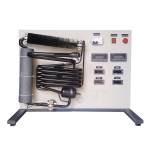
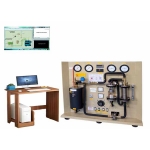
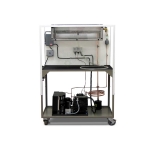
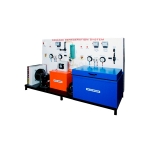
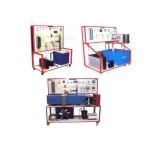
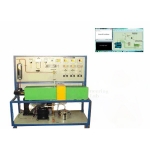
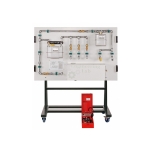
Computerized Cascade Refrigeration Trainer
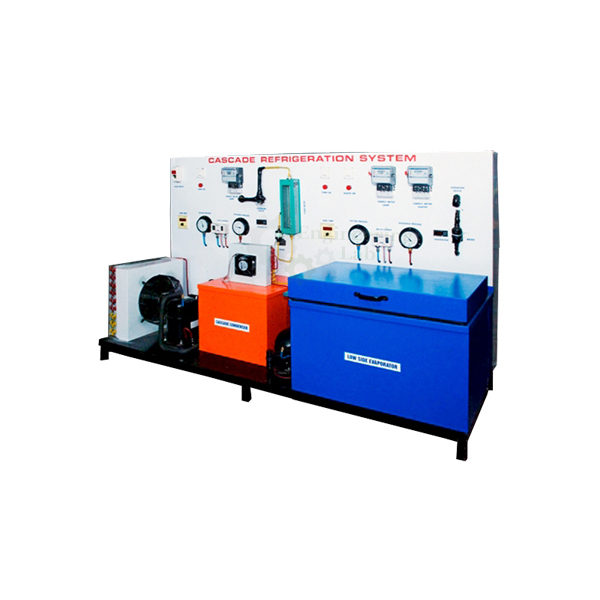
Product Code : EL-RAACLE-10789
Computerized Cascade Refrigeration Trainer (code EL-RAACLE-10789) is a two-stage compression refrigeration trainer with injection intercooling, used to show how particularly low temperatures are reached with two compressors in series. The low-pressure compressor (25,93 cm³, 1744 W at -10/32 °C) feeds the high-pressure compressor (8,86 cm³, 583 W), intercooling between them lowers the HP outlet temperature, and sensors pass all values to software in real time.
Get a quote: use the Add To Cart enquiry button below, or send your quantity and delivery location through the contact page.
Specifications
| Parameter | Detail |
|---|---|
| System | Refrigeration with two-stage compression and injection intercooling |
| Purpose | Generation of particularly low temperatures |
| Compressor arrangement | Two compressors in series, each with a relatively low pressure ratio |
| Intercooling | Between LP and HP compressors; reduces HP compressor outlet temperature and improves compression efficiency |
| Measurement | All relevant values recorded by sensors and displayed |
| Software | Simultaneous transmission to software for analysis and real-time log p-h diagram |
| Flow meters | Two: total volumetric flow rate and volumetric flow rate in the intercooling |
| Low-pressure compressor (LP) | |
| Displaced volume | 25,93 cm³ |
| Power consumption | 550 W |
| Refrigeration capacity | 1744 W at -10/32 °C |
| High-pressure compressor (HP) | |
| Displaced volume | 8,86 cm³ |
| Power consumption | Approx. 275 W |
| Refrigeration capacity | 583 W at -10/32 °C |
| Refrigerant | |
| Filling volume | 1,29 kg |
| CO2-equivalent | 1,8 t |
| Measuring ranges | |
| Flow rate | 2 to 29 L/h; 4 to 40 L/h |
| Pressure | 1 × -1 to 15 bar; 2 × -1 to 24 bar |
| Temperature | 8 × -75 to 125 °C |
| Power | 0 to 562 W (heater); 0 to 750 W (LP compressor); 0 to 2250 W (HP compressor) |
| Learning content | |
| System design | Design and function of a refrigeration system with two-stage compression and injection intercooling |
| HP inlet temperature | Effect of the inlet temperature at the HP compressor on compression efficiency |
| Extra intercooling | Effect of additional refrigerant intercooling |
| Pressure ratios | Distribution of the compressor pressure ratios |
| Cycle diagram | Refrigeration cycle in the log p-h diagram, with and without intercooling |
| Power, dimensions and weight | |
| Power supply | 230 V, 50 Hz, 1 phase; or 230 V, 60 Hz, 1 phase |
| Dimensions | Approx. 2000 × 800 × 1600 mm (L × W × H) |
| Weight | Approx. 265 kg |
| Supply | |
| Product code | EL-RAACLE-10789 |
| Manufacturer | Engineering Lab Equipment, Ambala, Haryana, India |
What Is the Computerized Cascade Refrigeration Trainer Used For?
At very low evaporating temperatures the pressure ratio across a single compressor becomes so high that its volumetric efficiency drops sharply and the discharge runs very hot. Splitting the compression between a larger low-pressure compressor and a smaller high-pressure one, with refrigerant injected between them for intercooling, keeps each pressure ratio moderate. Students run the system with and without intercooling, compare the pressure ratio of each stage and see how the HP inlet temperature affects compression efficiency, with all temperatures, pressures, powers and both flow rates logged and drawn as a log p-h process in real time.
What to Specify When Ordering
- Quantity — the number of cascade trainers to be quoted.
- Supply frequency — the 50 Hz or 60 Hz build, each for 230 V single phase.
Frequently Asked Questions
Why are two compressors used in series?
At very low temperatures a large pressure difference is needed between evaporator and condenser, and a single compressor loses volumetric efficiency at high pressure ratios, so two compressors share the compression.
What are the two compressor ratings?
The low-pressure compressor displaces 25,93 cm³, uses 550 W and gives 1744 W at -10/32 °C; the high-pressure compressor displaces 8,86 cm³, uses approx. 275 W and gives 583 W.
What does the intercooling do?
Injection intercooling between the LP and HP compressors lowers the outlet temperature of the HP compressor and improves the efficiency of compression; the trainer can be run with or without it.
Which flow rates are measured?
Two flow meters show the overall volumetric flow and the flow passing through the intercooling, with measuring ranges of 2 to 29 L/h and 4 to 40 L/h.
How are results displayed?
Sensors record all relevant values, which are displayed on the unit and sent simultaneously to software that analyses them and draws the process in real time.
What size is the trainer?
It occupies roughly 2000 by 800 mm of floor, stands about 1600 mm high and weighs some 265 kg, with eight temperature points measured from -75 to 125 °C.
OEM Manufacturer
Engineering Lab Equipment (Engineering Labs Equipment Pvt Ltd) builds the Computerized Cascade Refrigeration Trainer at its works in Saha, District Ambala, Haryana (Plot No. 43, Industrial Park, Sector 2, Growth Center). Its refrigeration and air conditioning trainers and test rigs go to engineering colleges, polytechnics, technical training institutes and research laboratories in India and abroad, and equipment can be made to an institution's own requirements. For tenders and OEM supply, see the Tenders/OEM page.
Related Refrigeration and Air Conditioning Equipment
- Vapour Absorption Refrigeration Trainer — ammonia-water absorption refrigeration demonstrator with hydrogen auxiliary gas and 125 W electric heater.
- Vapour Compression Refrigeration Trainer — refrigeration circuit trainer with glass evaporator and condenser, float valve and SES36 refrigerant.
- Computerized Bench Top Cold Storage Trainer — refrigeration chamber trainer with two evaporators, electric and hot gas defrost and USB data logging.
See the full Refrigeration and Air Conditioning Lab Equipment range or all Mechanical Engineering Lab Equipment.
Request a Quote
For this and other refrigeration and air conditioning lab equipment, schools and colleges can contact Engineering Lab Equipment, a manufacturer, supplier and exporter based in Ambala, India. For a price, send the number of trainers and whether the 50 Hz or the 60 Hz build is required and the delivery location through the contact page; the Add To Cart button on this page also adds the Computerized Cascade Refrigeration Trainer to an enquiry.
Last updated: October 2026