Four Stroke Four Cylinder Petrol Engine Test Bench
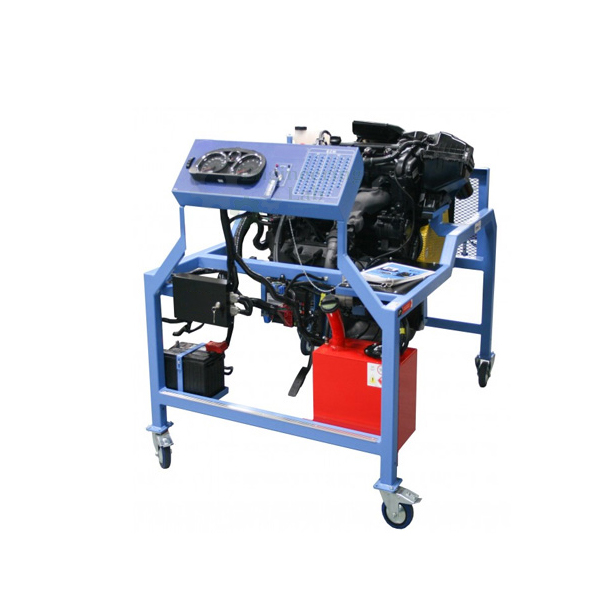
Product Code : EL-TELE-10696
Four Stroke Four Cylinder Petrol Engine Test Bench (code EL-TELE-10696) is an engine test stand on which a water-cooled, four-cylinder petrol engine is run against a load unit so that students can measure its torque, power, fuel consumption and efficiency. The 1086 cc spark ignition engine has a controlled catalytic converter and gives a maximum of 63 BHP at 5500 rpm and 89 Nm at 3000 rpm. It is carried on a welded frame on rollers and links to a PC through a single USB interface.
Get a quote: use the Add To Cart enquiry button below, or send your quantity and delivery location through the contact page.
Specifications
| Parameter | Detail |
|---|---|
| Engine | |
| Engine type | Four-cylinder, four-stroke petrol engine with controlled catalytic converter |
| Ignition | Spark ignition |
| Fuel | Petrol |
| Capacity | 1086 cc |
| Bore | 66 mm |
| Stroke length | 77 mm |
| Maximum power | 63 BHP at 5500 rpm |
| Maximum torque | 89 Nm at 3000 rpm |
| Cooling | Water-cooled, with its own closed cooling water circuit |
| Starting | Self-start |
| Battery | 12 V, 45A |
| Alternator | 12 V, 45A |
| Frame and load connection | |
| Frame | Welded frame on rollers; engine flexibly mounted on the mobile frame |
| Load unit connection | Engine attached to the load unit by fasteners; brake connected through a rotationally elastic coupling with jointed shaft |
| Guarding | Hot surfaces and rotating parts covered with perforated plates |
| Start interlock | Engine starts only when connected to the load unit both mechanically and electrically |
| Switch cabinet | Warning lamps for oil pressure and alternator failure, operating time counter and ignition key |
| Measurement and software | |
| Experiments | Torque and power curves; specific fuel consumption; volumetric efficiency and lambda (fuel-air ratio); energy balances; overall engine efficiency |
| Software | Engine software runs on a personal computer |
| PC connection | Single USB interface between the electronic console and the PC |
| Power required | 230 V, 50 Hz, 1 phase |
| Dimensions | 1200 × 1000 × 1200 mm (L × W × H) |
| Weight | Approx. 380 kg |
| Supply | |
| Product code | EL-TELE-10696 |
| Manufacturer | Engineering Lab Equipment, Ambala, Haryana, India |
What Is the Four Stroke Four Cylinder Petrol Engine Test Bench Used For?
Engine testing in a teaching laboratory means running an engine against a controlled brake load and measuring what it delivers and what it consumes. On this bench the operator couples the petrol engine to the load unit, starts it with the ignition key once the interlock is satisfied, and runs it at a series of speeds and loads. From the readings collected on the PC, students plot torque and power curves, work out specific fuel consumption, volumetric efficiency, lambda and overall efficiency, and draw up an energy balance showing how the fuel energy divides between useful power, cooling water and exhaust. The engine's own closed cooling water circuit cools it during the tests.
What to Specify When Ordering
- Quantity — the number of test benches required.
Frequently Asked Questions
What engine is fitted to this test bench?
A four-cylinder, four-stroke petrol engine of 1086 cc with spark ignition, a controlled catalytic converter and water cooling through its own closed circuit. Bore and stroke are 66 mm and 77 mm.
What are the engine's maximum power and torque?
The engine gives a maximum power of 63 BHP at 5500 rpm and a maximum torque of 89 Nm at 3000 rpm, as listed in its specifications.
Which experiments can students carry out?
They can plot torque and power curves and determine specific fuel consumption, volumetric efficiency and lambda (the fuel-air ratio), energy balances and the overall engine efficiency.
What safety measures are built in?
Perforated plates cover hot surfaces and rotating parts, and the engine has been modified so that it will start only once its mechanical and electrical connections to the load unit are both made.
How is test data handled?
Test data goes to a personal computer running the engine software, which is linked to the electronic console by one USB connection only.
How can this test bench be ordered?
Click the Add To Cart enquiry button on this page, or send the quantity and the delivery location through the contact page.
OEM Manufacturer
Engineering Lab Equipment (Engineering Labs Equipment Pvt Ltd) builds the Four Stroke Four Cylinder Petrol Engine Test Bench at its works in Saha, District Ambala, Haryana (Plot No. 43, Industrial Park, Sector 2, Growth Center). Its thermal engineering trainers, engine test rigs and steam and air apparatus go to engineering colleges, polytechnics, technical training institutes and research laboratories in India and abroad, and equipment can be made to an institution's own requirements. For tenders and OEM supply, see the Tenders/OEM page.
Related Thermal Engineering Equipment
- Four Stroke Four Cylinder Diesel Engines Test Bench — 1248 cc four-cylinder diesel engine test stand rated 74 BHP, with switch cabinet and start interlock.
- Multi Engine Test Bench — 11 kW asynchronous-motor engine test stand with energy recovery, diesel/petrol fuel systems and USB logging.
- Single Cylinder Four Stroke Diesel Engine Test Bench — 4.5 kW air-cooled single-cylinder direct injection diesel engine stand with drive and brake unit.
- Single Cylinder Four Stroke Petrol Engine Test Bench — 7.5 kW air-cooled single-cylinder carburettor petrol engine stand for brake power and efficiency tests.
See the full Thermal Engineering Lab Equipment range or all Mechanical Engineering Lab Equipment.
Request a Quote
For this and other thermal engineering lab equipment, schools and colleges can contact Engineering Lab Equipment, a manufacturer, supplier and exporter based in Ambala, India. For a price, send the number of petrol engine test benches required and the delivery location through the contact page; the Add To Cart button on this page also adds the Four Stroke Four Cylinder Petrol Engine Test Bench to an enquiry.
Last updated: October 2026