Four Stroke Four Cylinder Diesel Engines Test Bench
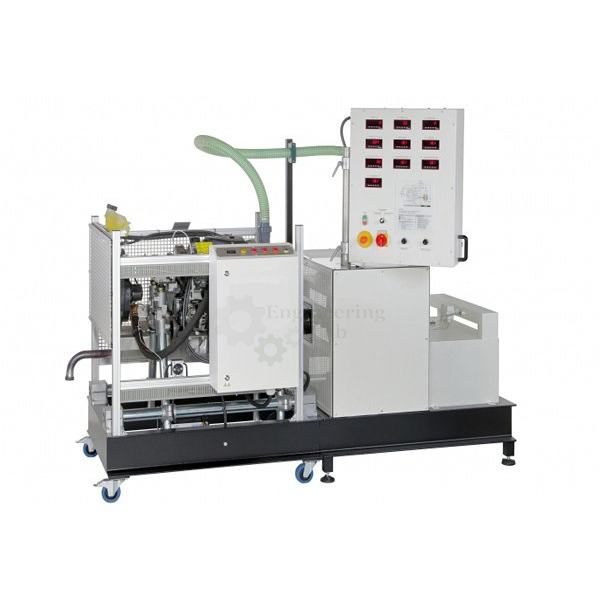
Product Code : EL-TELE-10697
Four Stroke Four Cylinder Diesel Engines Test Bench (code EL-TELE-10697) is a mobile test stand for running a 1248 cc, four-cylinder diesel engine under load from a load unit and studying its performance. The water-cooled, self-starting engine is rated at a maximum of 74 BHP at 4000 rpm and 190 Nm at 2000 rpm, and it carries sensors for temperatures and cooling water flow rate. A switch cabinet with factory-set engine management, ignition key, operating time counter and warning lamps is fitted.
Get a quote: use the Add To Cart enquiry button below, or send your quantity and delivery location through the contact page.
Specifications
| Parameter | Detail |
|---|---|
| Diesel engine | |
| Engine | Four-cylinder, four-stroke diesel engine |
| Fuel | Diesel |
| Displacement | 1248 cc |
| Bore and stroke | 69.9 mm bore, 82 mm stroke |
| Peak power | 74 BHP at 4000 rpm |
| Peak torque | 190 Nm at 2000 rpm |
| Cooling system | Water-cooled; closed cooling water circuit |
| Starting system | Self-start, with starter battery housed in the frame |
| Battery and alternator | Battery 12 V, 45A; alternator 12 V, 45A |
| Sensors | Temperatures and cooling water flow rate |
| Stand and controls | |
| Mobile frame | Welded frame on rollers carrying the flexibly mounted engine |
| Brake connection | Rotationally elastic coupling with jointed shaft; engine fastened to the load unit |
| Protective covers | Perforated plates over hot surfaces and rotating parts |
| Switch cabinet | Houses the factory-set electronic equipment for managing the engine; ignition key, operating time counter, warning lamps for oil pressure and alternator failure |
| Data link | Data cable between the switch cabinets of the engine and the load unit |
| Safety interlock | Engine starts only when connected to the load unit both mechanically and electrically |
| Test results | Torque and power curves, specific fuel consumption, volumetric efficiency and lambda (fuel-air ratio), energy balances, overall engine efficiency |
| Electrical supply | 230 V, 50 Hz, 1 phase |
| Dimensions | 1200 × 1000 × 1200 mm (L × W × H) |
| Weight | Approx. 410 kg |
| Supply | |
| Product code | EL-TELE-10697 |
| Manufacturer | Engineering Lab Equipment, Ambala, Haryana, India |
What Is the Four Stroke Four Cylinder Diesel Engines Test Bench Used For?
A diesel engine ignites its fuel by the heat of compression rather than a spark, and its performance on test is judged from the torque and power it gives against the fuel it burns. Students fasten the engine to the load unit, connect the data cable between the two switch cabinets, start it with the ignition key and load it through the elastic coupling and jointed shaft. Running at different speeds and loads, they record temperatures and cooling water flow, then plot torque and power curves and calculate specific fuel consumption, volumetric efficiency, lambda, overall efficiency and the energy balance of the engine.
What to Specify When Ordering
- Quantity — the number of diesel engine test benches required.
Frequently Asked Questions
What size is the diesel engine, and how many cylinders does it have?
The engine has four cylinders and a capacity of 1248 cc, with a 69.9 mm bore and an 82 mm stroke. It is water-cooled and works on the four-stroke cycle.
How much power and torque does it develop?
Maximum power is 74 BHP at 4000 rpm, and maximum torque is 190 Nm, reached at 2000 rpm, on diesel fuel.
What does the switch cabinet contain?
It houses all of the factory-set electronic equipment for managing the engine, together with an ignition key, an operating time counter and warning lamps for oil pressure and alternator failure.
How do the engine and load unit exchange data?
A data cable connects the switch cabinet of the engine with that of the load unit, and the engine will only start once the two are joined both mechanically and electrically.
What can be determined in experiments?
Torque and power curves, specific fuel consumption, volumetric efficiency, lambda (fuel-air ratio), energy balances and overall engine efficiency can all be found from the test runs.
What electrical supply and floor space are needed?
The bench takes a 230 V, 50 Hz, 1 phase supply. It measures 1200 × 1000 × 1200 mm and weighs approximately 410 kg.
OEM Manufacturer
Buyers of the Four Stroke Four Cylinder Diesel Engines Test Bench deal directly with its maker, Engineering Lab Equipment (Engineering Labs Equipment Pvt Ltd), whose works are at Plot No. 43, Industrial Park, Sector 2, Growth Center, Saha, District Ambala, Haryana, India. The company designs, makes and tests thermal engineering trainers, engine test rigs and steam and air apparatus, supplies engineering colleges, polytechnics, technical training institutes and research laboratories in India and overseas, and builds to institution-specific requirements on request. Tender details are on the Tenders/OEM page.
Related Thermal Engineering Equipment
- Four Stroke Four Cylinder Petrol Engine Test Bench — 1086 cc four-cylinder petrol engine test stand with catalytic converter, 63 BHP and USB data link.
- Multi Engine Test Bench — 11 kW asynchronous-motor engine test stand with energy recovery, diesel/petrol fuel systems and USB logging.
- Single Cylinder Four Stroke Diesel Engine Test Bench — 4.5 kW air-cooled single-cylinder direct injection diesel engine stand with drive and brake unit.
- Single Cylinder Two Stroke Petrol Engines Test Bench — load and control unit with asynchronous motor brake for single-cylinder engines up to 3 kW.
See the full Thermal Engineering Lab Equipment range or all Mechanical Engineering Lab Equipment.
Request a Quote
For this and other thermal engineering lab equipment, schools and colleges can contact Engineering Lab Equipment, a manufacturer, supplier and exporter based in Ambala, India. Quotations are given on request: send the number of diesel engine test benches required and your delivery location through the contact page, or add the Four Stroke Four Cylinder Diesel Engines Test Bench to the enquiry cart from this page.
Last updated: October 2026