Single Cylinder Two Stroke Petrol Engines Test Bench
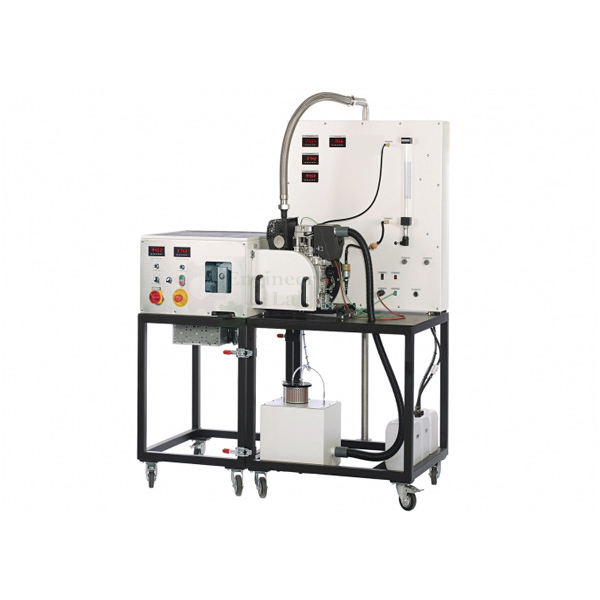
Product Code : EL-TELE-10704
Single Cylinder Two Stroke Petrol Engines Test Bench (code EL-TELE-10704) is a load and control stand for testing single-cylinder internal combustion engines of up to 3 kW, in which one asynchronous motor serves as both starter and brake. The engine sits on a vibration-insulated base plate, the braking energy is fed back into the electrical system through an energy recovery unit, and torque, speed, air and fuel consumption and temperatures are displayed and sent to a PC over USB.
Get a quote: use the Add To Cart enquiry button below, or send your quantity and delivery location through the contact page.
Specifications
| Parameter | Detail |
|---|---|
| Application | Control and load unit for single-cylinder internal combustion engines up to 3 kW |
| Load unit | Asynchronous motor used as brake and as starter motor, with energy recovery unit |
| Power output | Approx. 3 kW at 2900 min-1 |
| Braking energy | Fed back into the electrical system |
| Engine base | Vibration-insulated base plate on soft bearing support, for smooth running |
| Frame | Mobile frame with fuel tanks and an intake air stabilisation tank in its lower section |
| Air consumption measurement | Measuring nozzle |
| Fuel consumption measurement | Level in a vertical pipe |
| Displayed values | Torque, speed, air temperature, air intake quantity, negative intake pressure, fuel consumption and fuel temperature |
| Engine displays | Exhaust gas temperature and cooling water temperatures |
| Pressure gauges | Negative intake pressure and air consumption |
| Torque range | -50 to 50 Nm |
| Speed range | 0–5000 min-1 |
| Temperature range | 0–900 °C |
| Fuel consumption range | 50 cm³/min |
| Intake pressure range | -400 to 0 mbar |
| Air consumption range | 0–690 L/h |
| Data acquisition | Measured values sent directly to a PC via USB; software included |
| Experiments | Torque and power curves; specific fuel consumption; volumetric efficiency and lambda (fuel-air ratio); frictional power in passive mode |
| Power supply | 230 V, 60 Hz, 1 phase |
| Dimensions | 1200 × 800 × 1200 mm (L × W × H) |
| Weight | Approx. 110 kg |
| Product code | EL-TELE-10704 |
| Manufacturer | Engineering Lab Equipment, Ambala, Haryana, India |
What Is the Single Cylinder Two Stroke Petrol Engines Test Bench Used For?
A two-stroke petrol engine completes its working cycle in one crankshaft revolution, and the bench measures how such a small single-cylinder engine performs across its speed range. The asynchronous motor spins the engine to start it and then absorbs its power as a brake; the operator reads torque and speed while air consumption is taken from the measuring nozzle and fuel consumption from the level in the vertical pipe. Students use these readings, logged on the PC, to plot torque and power curves and to calculate specific fuel consumption, volumetric efficiency and lambda. In passive mode, the asynchronous motor turns the engine over so that its frictional power can be found.
What to Specify When Ordering
- Quantity — the number of test benches required.
Frequently Asked Questions
What engines can this bench take?
It is a control and load unit for single-cylinder internal combustion engines with outputs up to 3 kW; the listed power output is approximately 3 kW at 2900 min-1.
How is the engine started and loaded?
One asynchronous motor does both jobs: it starts the engine and, once the engine runs, works with the energy recovery unit as a brake, feeding the braking power back into the electrical system.
How are air and fuel consumption measured?
Air consumption is measured with a measuring nozzle and shown on a pressure gauge, while fuel consumption is measured from the level in a vertical pipe.
What are the measuring ranges?
Torque -50 to 50 Nm, speed 0 to 5000 min-1, temperature 0 to 900 °C, fuel consumption 50 cm³/min, intake pressure -400 to 0 mbar and air consumption 0 to 690 L/h.
How is frictional power found?
When the engine is in passive mode, the asynchronous motor turns it over, and the power this takes gives the frictional power of the engine.
Why is the engine mounted on a vibration-insulated base plate?
The heavy base plate on its soft bearing support lets the stand run smoothly while the single-cylinder engine is under load, and it carries the engine coupled to the asynchronous motor.
OEM Manufacturer
The Single Cylinder Two Stroke Petrol Engines Test Bench is made by Engineering Lab Equipment (Engineering Labs Equipment Pvt Ltd) at its works at Plot No. 43, Industrial Park, Sector 2, Growth Center, Saha, District Ambala, Haryana, India. The company designs, makes and tests thermal engineering trainers, engine test rigs and steam and air apparatus for engineering colleges, polytechnics, technical training institutes and research laboratories in India and overseas, and can build equipment to an institution's own requirements. Tender and OEM enquiries are handled through the Tenders/OEM page.
Related Thermal Engineering Equipment
- Single Cylinder Four Stroke Petrol Engine Test Bench — 7.5 kW air-cooled single-cylinder carburettor petrol engine stand for brake power and efficiency tests.
- Single Cylinder Four Stroke Diesel Engine Test Bench — 4.5 kW air-cooled single-cylinder direct injection diesel engine stand with drive and brake unit.
- Four Stroke Four Cylinder Petrol Engine Test Bench — 1086 cc four-cylinder petrol engine test stand with catalytic converter, 63 BHP and USB data link.
- Multi Engine Test Bench — 11 kW asynchronous-motor engine test stand with energy recovery, diesel/petrol fuel systems and USB logging.
See the full Thermal Engineering Lab Equipment range or all Mechanical Engineering Lab Equipment.
Request a Quote
For this and other thermal engineering lab equipment, schools and colleges can contact Engineering Lab Equipment, a manufacturer, supplier and exporter based in Ambala, India. To ask for a quotation, send the number of two-stroke engine test benches required and your delivery location through the contact page, or use the Add To Cart enquiry button on this page.
Last updated: October 2026