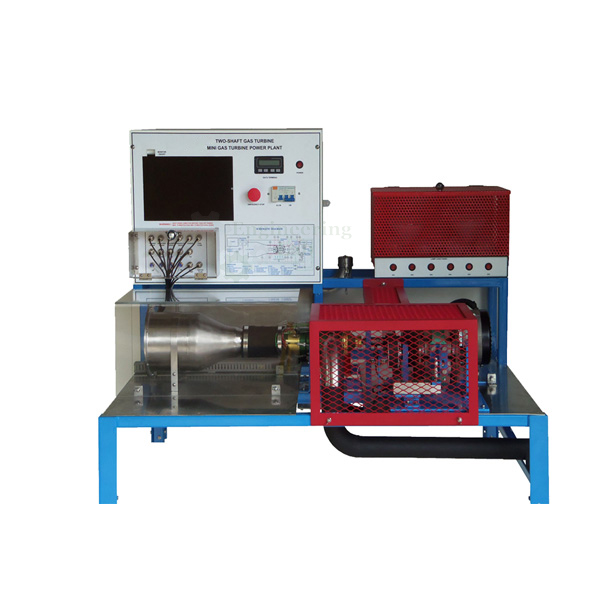
Two Shaft Gas Turbine Test Bench
Product Code : EL-TELE-10707
Two Shaft Gas Turbine Test Bench (code EL-TELE-10707) is a kerosene-powered, self-contained and fully instrumented teaching gas turbine for practical investigation of how two-shaft gas turbines work and perform. A gas generator shaft with radial flow compressor and single-stage axial flow turbine supplies hot gas to a larger power turbine on the second shaft, which works against a hydraulic, water-cooled dynamometer. A touch screen interface, hour meter and sensors for temperatures, pressures, speeds, torque and fuel and air flow are fitted.
Get a quote: use the Add To Cart enquiry button below, or send your quantity and delivery location through the contact page.
Specifications
| Parameter | Detail |
|---|---|
| Engine | Small two-shaft gas turbine engine with radial flow compressor and axial flow turbine |
| Fuel | Kerosene |
| First shaft | Gas generator providing hot gas for a single-stage axial flow turbine |
| Second shaft | Larger power turbine receiving the hot gas axially and exhausting to atmosphere |
| Air path | Calibrated nozzle and air box, then compressor and combustion chamber |
| Fuel system | Pump transferring fuel from the fuel tank to spray through a special nozzle into the combustion chamber |
| Ignition | High-energy spark |
| Combustion chamber | Low pressure loss and flame stability over a wide range of conditions |
| Speed control | Fuel flow control valve on the instrumentation and control panel, reducing the possibility of overspeed |
| Starter | Automatic front motor starter |
| Bearings and lubrication | Ceramic bearings; lubricant oil mixed with the fuel |
| Dynamometer | Hydraulic, water-cooled |
| Sensors and indicators | Temperatures, pressures, speeds, torque, fuel flow rate and airflow rate |
| Hour meter | Logs operating hours |
| Operator interface | Human-machine interface with touch screen |
| Experiments | Specific fuel consumption; pressure losses and ratios; thermal, isentropic and mechanical efficiencies; work and power |
| Power supply | 220 V, 1 ph, 50 Hz |
| Dimensions | 1400 × 900 × 1700 mm (L × W × H) |
| Weight | Approx. 380 kg |
| Product code | EL-TELE-10707 |
| Manufacturer | Engineering Lab Equipment, Ambala, Haryana, India |
What Is the Two Shaft Gas Turbine Test Bench Used For?
In a two-shaft gas turbine the first shaft is a gas generator, a compressor driven by its own turbine, and its hot exhaust then drives a separate power turbine on the second shaft that delivers the output, the arrangement used where shaft power is needed, as in helicopters or electrical power generators. Students start the engine with the front motor starter, set the turbine speed with the fuel flow control valve and load the power turbine with the water-cooled dynamometer. The readings of temperatures, pressures, speeds, torque and fuel and air flow let them find specific fuel consumption, pressure ratios and losses, work and power, and the thermal, isentropic and mechanical efficiencies.
What to Specify When Ordering
- Quantity — the number of gas turbine test benches required.
Frequently Asked Questions
How do the two shafts of the turbine work together?
The first shaft is the gas generator, giving hot gas for its single-stage axial flow turbine; the gas then passes axially to the larger power turbine on the second shaft and exhausts to atmosphere.
What fuel does it use and how is it ignited?
It is powered by kerosene, which a pump sprays through a special nozzle into the combustion chamber, where a high-energy spark ignites the air and fuel mixture.
How is overspeed avoided?
Turbine speed is regulated by a fuel flow control valve on the instrumentation and control panel, a design that reduces the possibility of overspeed.
How is the engine lubricated?
It runs on ceramic bearings, which are lubricated by lubricant oil mixed into the kerosene fuel.
What can students measure and calculate?
Sensors and indicators cover temperatures, pressures, speeds, torque, fuel flow rate and airflow rate, from which specific fuel consumption, pressure losses and ratios, efficiencies, work and power are found.
Where are two-shaft gas turbines used in practice?
An engine with a secondary power turbine of this kind is used in practical applications such as helicopters and electrical power generators.
OEM Manufacturer
The Two Shaft Gas Turbine Test Bench is made by Engineering Lab Equipment (Engineering Labs Equipment Pvt Ltd) at its works at Plot No. 43, Industrial Park, Sector 2, Growth Center, Saha, District Ambala, Haryana, India. The company designs, makes and tests thermal engineering trainers, engine test rigs and steam and air apparatus for engineering colleges, polytechnics, technical training institutes and research laboratories in India and overseas, and can build equipment to an institution's own requirements. Tender and OEM enquiries are handled through the Tenders/OEM page.
Related Thermal Engineering Equipment
- Turbo Jet Engine Test Bench — small jet engine test stand with 82 N maximum thrust, automatic electric start and USB logging.
- Axial Flow Turbine Test Bed — gas turbine engine test rig with 200 N typical thrust, single-pivot thrust mount and USB data logging.
- Rotary Air Compressor Test Bench — rotary vane compressor rig with 3 HP motor, orifice meter, energy meter and USB data logging.
- Single Stage Air Compressor Setup with Data Acquisition — single-stage piston air compressor rig, 750 W, 150 L/min at 8 bar, with 20 L vessels.
See the full Thermal Engineering Lab Equipment range or all Mechanical Engineering Lab Equipment.
Request a Quote
For this and other thermal engineering lab equipment, schools and colleges can contact Engineering Lab Equipment, a manufacturer, supplier and exporter based in Ambala, India. To ask for a quotation, send the number of two-shaft gas turbine test benches required and your delivery location through the contact page, or use the Add To Cart enquiry button on this page.
Last updated: October 2026