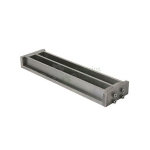
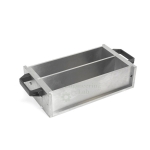
Briquette Mould (Single)

Product Code : EL-CTLE-10909
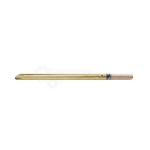
Briquette Mould (Single) (code EL-CTLE-10909) is a gun metal mould, split into two parts, for casting cement briquettes for tensile strength tests. Two thumb screws are used to assemble and dismantle it, the briquettes cast in it have a minimum cross section of 25.4 mm × 25.4 mm, and a steel base plate is supplied with the mould.
Get a quote: use the Add To Cart enquiry button below, or send your quantity and delivery location through the contact page.
Specifications
| Parameter | Detail |
|---|---|
| Use | Casting cement briquettes for tensile strength tests |
| Type | Two-part split mould |
| Material | Gun metal |
| Assembly | Two thumb screws for assembling and dismantling |
| Briquette cross section | Minimum 25.4 mm × 25.4 mm |
| Supplied with | Steel base plate |
| Standards | IS 269 1958, BS 12 |
| Product code | EL-CTLE-10909 |
| Manufacturer | Engineering Lab Equipment, Ambala, Haryana, India |
What Is the Briquette Mould (Single) Used For?
A briquette is a waisted cement mortar specimen that is pulled apart in a tensile tester, the narrow waist fixing where it breaks. The mould halves are joined with the thumb screws and set on the steel base plate, the mortar is pressed into the cavity and levelled, and once it has set the screws are loosened so that the split mould opens without damaging the briquette. The briquette is then cured and broken, and its strength is worked out over the minimum section of 25.4 mm × 25.4 mm.
What to Specify When Ordering
- Quantity — the number of moulds required.
Frequently Asked Questions
What is the Briquette Mould (Single) made of?
Gun metal is used for both halves of this split mould, which is put together and taken apart with two thumb screws and comes with a steel base plate.
What size of briquette does it cast?
The briquettes cast in it have a minimum cross section of 25.4 mm × 25.4 mm, the section over which the tensile strength is worked out.
Why is the mould split into two parts?
A split mould can be opened by loosening the thumb screws, so the set briquette is released without being pulled or knocked out of the cavity.
Which standards are listed?
The standards listed for the Briquette Mould (Single) are IS 269 1958 and BS 12.
How can moulds be ordered?
Moulds can be requested with the Add To Cart enquiry button, or by giving the quantity and delivery location on the contact page.
OEM Manufacturer
Engineering Lab Equipment (Engineering Labs Equipment Pvt Ltd) builds the Briquette Mould (Single) at its works in Saha, District Ambala, Haryana (Plot No. 43, Industrial Park, Sector 2, Growth Center). Its cement testing equipment such as Vicat and Blaine apparatus, moulds, mixers and curing equipment go to engineering colleges, polytechnics, technical training institutes and research laboratories in India and abroad, and equipment can be made to an institution's own requirements. For tenders and OEM supply, see the Tenders/OEM page.
Related Cement Testing Equipment
- Bulk Density Apparatus — hopper and spring loaded yoke over a 1 litre cylinder for measuring lime bulk density.
- 50 mm Three Gang Cube Mould — machined steel mould forming three 50 mm cement mortar cubes for compression testing.
- Flexural Test Devices for Mortar Beams — spring-loaded three-point bending jig for mortar beams with 100 mm (EN) or 119 mm (ASTM) bearers.
- Carbon Dioxide Content in Cement — absorption train with distillation flask, mantle heater, condenser and weighed absorption tubes for cement CO2.
See the full Cement Testing Lab Equipment range or all Civil Engineering Lab Equipment.
Request a Quote
For this and other cement testing lab equipment, schools and colleges can contact Engineering Lab Equipment, a manufacturer, supplier and exporter based in Ambala, India. For a price, send the number of briquette moulds required and the delivery location through the contact page; the Add To Cart button on this page also adds the Briquette Mould (Single) to an enquiry.
Last updated: October 2026