Hydraulic Shrinkage Mould 25x25x285 mm
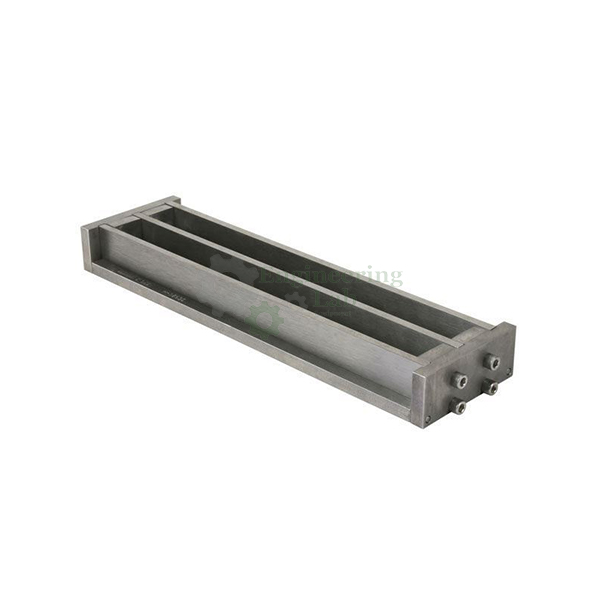
Product Code : EL-CTLE-10347
Hydraulic Shrinkage Mould 25x25x285 mm (code EL-CTLE-10347) is a mould that casts two prisms at a time for measuring the change in length caused by shrinkage. Each prism is 25 × 25 × 285 mm and carries contact points, supplied with the mould, that mark out a 250 mm gauge length, and the mould weighs approximately 6 kg.
Get a quote: use the Add To Cart enquiry button below, or send your quantity and delivery location through the contact page.
Specifications
| Parameter | Detail |
|---|---|
| Use | Casting prisms for shrinkage measurement |
| Mould type | Two gang |
| Prism size | 25 × 25 × 285 mm |
| Supplied with | Contact points |
| Gauge length | 250 mm |
| Total length | 285 mm |
| Weight | Approx. 6 kg |
| Standards | ASTM C151, ASTM C490, ASTM C596 |
| Product code | EL-CTLE-10347 |
| Manufacturer | Engineering Lab Equipment, Ambala, Haryana, India |
What Is the Hydraulic Shrinkage Mould 25x25x285 mm Used For?
Drying shrinkage of cement mortar is measured as a change in the length of slender prisms over time. Mortar is placed in both compartments around the contact points, which are cast into the ends of each prism and give fixed points to measure between. After demoulding, the length over the 250 mm gauge length is read in a comparator at the first age and again at each later age, and the change is expressed as a percentage of the gauge length. The standards listed are ASTM C151, ASTM C490 and ASTM C596.
What to Specify When Ordering
- Quantity — the number of moulds required.
Frequently Asked Questions
What specimens does this mould produce?
It is a two gang mould, so each filling produces two prisms of 25 × 25 × 285 mm for shrinkage measurement in the cement laboratory.
What is the gauge length of the prisms?
The prisms have a 250 mm gauge length between the contact points, within an overall length of 285 mm.
Are contact points included?
Yes. The mould is supplied complete with contact points, which are cast into the prism ends to give fixed points for length readings.
How much does the mould weigh?
The mould weighs approximately 6 kg; the standards listed are ASTM C151, ASTM C490 and ASTM C596.
How can this mould be ordered?
Send the number of moulds and where they are to be delivered via the contact page, or press the Add To Cart enquiry button shown on this page.
OEM Manufacturer
The Hydraulic Shrinkage Mould 25x25x285 mm is made by Engineering Lab Equipment (Engineering Labs Equipment Pvt Ltd) at its works at Plot No. 43, Industrial Park, Sector 2, Growth Center, Saha, District Ambala, Haryana, India. The company designs, makes and tests cement testing equipment such as Vicat and Blaine apparatus, moulds, mixers and curing equipment for engineering colleges, polytechnics, technical training institutes and research laboratories in India and overseas, and can build equipment to an institution's own requirements. Tender and OEM enquiries are handled through the Tenders/OEM page.
Related Cement Testing Equipment
- Sand Content of Drilling Muds — 2¼ inch 200-mesh sieve in a collar with top and bottom funnels for drilling mud sand content.
- Flow Tables for Mortar and Building Lime — manual or motor-driven drop table with flow mould and tamper for mortar and lime consistency.
- Gillmore Needle Apparatus — setting time apparatus with 113 g initial and 453.6 g final weighted steel needles on horizontal arms.
- Cement – Autoclave, High Pressure — high-pressure steam vessel, 154 mm dia. × 430 mm, with 10-specimen rack and 2600 W heater.
- Length Comparator — two-column steel frame with adjustable anvil and 12.5 × 0.001 mm digital gauge for mortar specimens.
See the full Cement Testing Lab Equipment range or all Civil Engineering Lab Equipment.
Request a Quote
For this and other cement testing lab equipment, schools and colleges can contact Engineering Lab Equipment, a manufacturer, supplier and exporter based in Ambala, India. To ask for a quotation, send the number of two gang moulds required and your delivery location through the contact page, or use the Add To Cart enquiry button on this page.
Last updated: October 2026