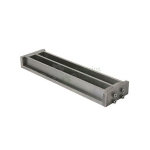
Hydraulic Shrinkage Mould
Product Code : EL-CTLE-10346
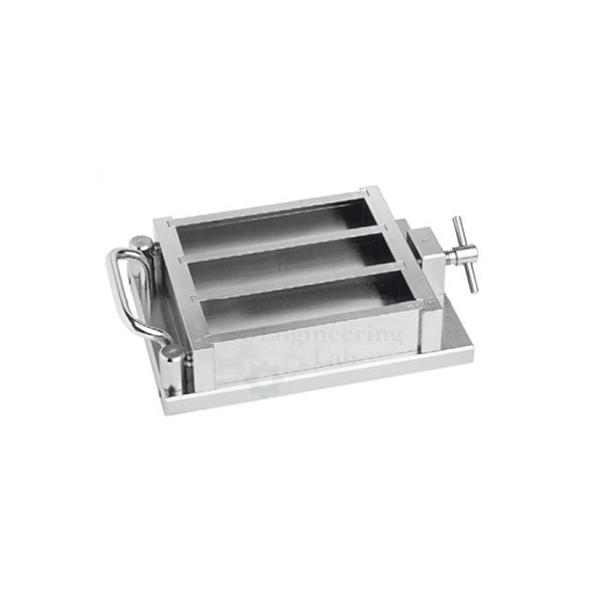
Hydraulic Shrinkage Mould (code EL-CTLE-10346) is a three gang mould for casting cement mortar specimens whose linear shrinkage is then followed on the Length Comparator. Built from special alloy steel of HV200 minimum hardness and individually tested, it weighs approximately 12 kg, and with two 15 × 40 × 160 mm plastic inserts fitted in each compartment the same mould also serves for grouts.
Get a quote: use the Add To Cart enquiry button below, or send your quantity and delivery location through the contact page.
Specifications
| Parameter | Detail |
|---|---|
| Use | Determination of linear shrinkage of cement mortars |
| Mould type | Three gang |
| Material | Special alloy steel |
| Hardness | Minimum HV200 |
| Testing | Individually tested |
| Grout testing | Same mould used for grouts to EN 12808-4, with the standard plugs replaced and two 15 × 40 × 160 mm plastic inserts placed inside each compartment |
| Shrinkage measurement | With the Length comparator |
| Weight | Approx. 12 kg |
| Standards | EN 12617-4, EN 12808-4, NF P15-413 |
| Product code | EL-CTLE-10346 |
| Manufacturer | Engineering Lab Equipment, Ambala, Haryana, India |
What Is the Hydraulic Shrinkage Mould Used For?
Cement mortars shrink as they dry, and too much shrinkage leads to cracking and loss of bond, so linear shrinkage is measured on cast specimens. The three compartments are filled with mortar and compacted, and the hardened specimens are demoulded; each is read on the Length Comparator and read again at every test age as it dries, the change in length giving the shrinkage. For grouts, the standard plugs are replaced and two plastic inserts are set in each compartment before casting. The standards listed are EN 12617-4, EN 12808-4 and NF P15-413.
What to Specify When Ordering
- Quantity — the number of moulds required.
- Application — mortar shrinkage tests, grout tests with the 15 × 40 × 160 mm plastic inserts, or both.
Frequently Asked Questions
What does the Hydraulic Shrinkage Mould test?
It casts three cement mortar specimens at a time for linear shrinkage tests, and their shrinkage is measured afterwards on the Length Comparator.
What is the mould made of?
Special alloy steel is used, with a hardness of at least HV200, and every mould is individually tested.
Can grouts be tested in the same mould?
Yes. For grouts the standard plugs are replaced and two 15 × 40 × 160 mm plastic inserts are placed inside each compartment; the standard listed for grout testing is EN 12808-4.
How is the shrinkage measured?
The specimens are measured on the Length Comparator after demoulding and again at later ages, and the change in length shows how much the mortar has shrunk.
How heavy is the mould?
The three gang mould, made of special alloy steel, weighs approximately 12 kg without its specimens.
Which standards are listed for it?
The standards listed are EN 12617-4 for mortars, EN 12808-4 for grouts, and NF P15-413.
OEM Manufacturer
Buyers of the Hydraulic Shrinkage Mould deal directly with its maker, Engineering Lab Equipment (Engineering Labs Equipment Pvt Ltd), whose works are at Plot No. 43, Industrial Park, Sector 2, Growth Center, Saha, District Ambala, Haryana, India. The company designs, makes and tests cement testing equipment such as Vicat and Blaine apparatus, moulds, mixers and curing equipment, supplies engineering colleges, polytechnics, technical training institutes and research laboratories in India and overseas, and builds to institution-specific requirements on request. Tender details are on the Tenders/OEM page.
Related Cement Testing Equipment
- Laboratory Cement Autoclave — stainless steel cement autoclave with PID heater control, safety valve and vertical test bar rack.
- Cement Curing Cabinet — polypropylene humidity cabinet at 20±1 °C and 95% to saturation with four stainless steel racks.
- Automatic Vicat Apparatus — automatic setting time tester with encoder penetration reading, 4.3 inch touch screen, LAN and USB ports.
- Mortar Mixer Machine — mortar mixer with a 6 litre bowl and adjustable revolving and planar speeds.
- Reactivity Test Apparatus — quicklime reactivity set with 1000 ml Dewar vessel, stirring motor and digital or datalog thermometer.
See the full Cement Testing Lab Equipment range or all Civil Engineering Lab Equipment.
Request a Quote
For this and other cement testing lab equipment, schools and colleges can contact Engineering Lab Equipment, a manufacturer, supplier and exporter based in Ambala, India. Quotations are given on request: send the number of moulds and whether they are for mortar or grout shrinkage tests and your delivery location through the contact page, or add the Hydraulic Shrinkage Mould to the enquiry cart from this page.
Last updated: October 2026