Brushes
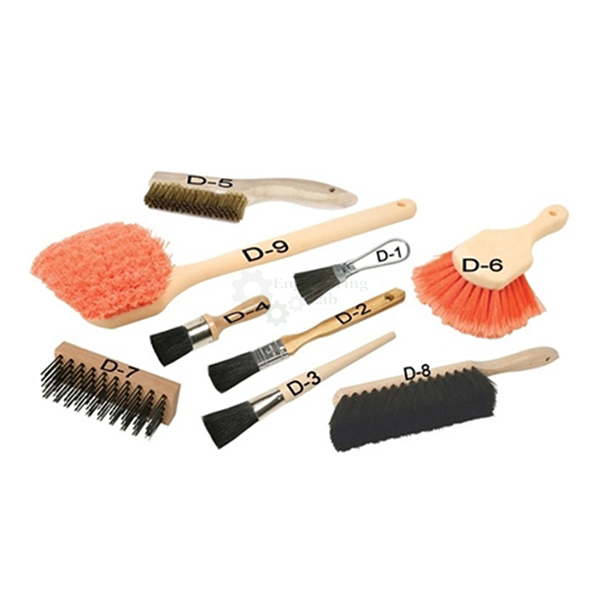
Product Code : EL-LEAA-10556
Brushes (code EL-LEAA-10556) are laboratory cleaning brushes used to remove residue from labware such as burets, cylinders and volumetric flasks. The range covers buret brushes, cylinder brushes, polyester volumetric flask brushes and black bristle brushes, with each type matched to the piece of labware it is meant to clean.
Get a quote: use the Add To Cart enquiry button below, or send your quantity and delivery location through the contact page.
Specifications
| Parameter | Detail |
|---|---|
| Types | Buret brushes, cylinder brushes, black bristle brushes and polyester volumetric flask brushes |
| Use | Cleaning residue from burets, cylinders and volumetric flasks |
| Buret brushes | For cleaning burets |
| Cylinder brushes | For cleaning cylinders |
| Volumetric flask brushes | Polyester, for cleaning volumetric flasks |
| Black bristle brushes | A further type in the range |
| Product code | EL-LEAA-10556 |
| Manufacturer | Engineering Lab Equipment, Ambala, Haryana, India |
What Are the Brushes Used For?
Residue left inside long or narrow-necked labware can upset later work, because a film on the wall changes how liquid drains and can carry over into the next sample. The user wets the brush, adds a cleaning solution, works the brush along the inside of the buret, cylinder or volumetric flask to loosen the residue, and then rinses the item. Each brush type is matched to its own vessel, so the bristles reach the inner walls of that shape of labware.
What to Specify When Ordering
- Quantity — the number of brushes of each type required.
- Brush type — buret, cylinder, black bristle or polyester volumetric flask brushes.
Frequently Asked Questions
Which brush types are offered?
The range includes buret brushes, cylinder brushes, black bristle brushes and polyester volumetric flask brushes, each intended for its own kind of labware.
What are the brushes used to clean?
They clean residue from labware, with buret brushes for burets, cylinder brushes for cylinders and volumetric flask brushes for volumetric flasks.
What material is used for the volumetric flask brush?
The volumetric flask brushes are made with polyester, which sets them apart from the black bristle brushes that are also part of the range.
Why should burets and volumetric flasks be brushed clean?
A film of residue on the inner wall makes liquid cling as drops instead of draining evenly, which upsets the volume delivered or contained, so the walls are brushed clean and rinsed.
OEM Manufacturer
Buyers of the Brushes deal directly with its maker, Engineering Lab Equipment (Engineering Labs Equipment Pvt Ltd), whose works are at Plot No. 43, Industrial Park, Sector 2, Growth Center, Saha, District Ambala, Haryana, India. The company designs, makes and tests general laboratory equipment and accessories such as ovens, baths, balances and measuring tools, supplies engineering colleges, polytechnics, technical training institutes and research laboratories in India and overseas, and builds to institution-specific requirements on request. Tender details are on the Tenders/OEM page.
Related Laboratory Equipment and Accessories
- Hand Gloves — latex chemical resistance gloves with beaded cuff for cleaning and washing work.
- Plastic Wash Bottles — squeezable plastic laboratory bottles with screw-top lid and long stem nozzle for reagents and solvents.
- Funnels and Flasks — range of volumetric, filter, extraction and conical flasks with glass and Buchner funnels.
- Evaporating Dishes — shallow porcelain or borosilicate glass vessel with pouring spout for evaporating solutions over a burner.
See the full Laboratory Equipment and Accessories range or all Civil Engineering Lab Equipment.
Request a Quote
For this and other laboratory equipment and accessories, schools and colleges can contact Engineering Lab Equipment, a manufacturer, supplier and exporter based in Ambala, India. Quotations are given on request: send the brush types and the number of each required and your delivery location through the contact page, or add the Brushes to the enquiry cart from this page.
Last updated: October 2026