Crank and Connecting Rod Apparatus

Product Code : EL-AMLE-10622
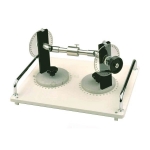
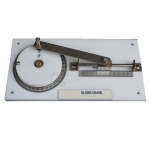
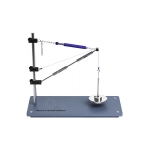
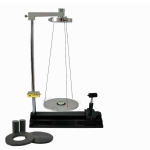
Crank and Connecting Rod Apparatus (code EL-AMLE-10622) is an experimental unit used to study how a crank and connecting rod turn the rotation of a crank disk into the stroke of a piston. It comprises a rotating crank disk, a connecting rod and a fixed cylinder whose end models the piston; the crank can be set at three radii on the disk, the crank angle is read on a scale in the base plate and the stroke on a steel ruler graduated in millimetres.
Get a quote: use the Add To Cart enquiry button below, or send your quantity and delivery location through the contact page.
Specifications
| Parameter | Detail |
|---|---|
| Use | Study of the stroke movement produced by a crank slider |
| Main parts | Rotating crank disk, connecting rod and fixed cylinder |
| Crank connection | Connecting rod joined to the crank disk through a crank |
| Piston model | Connecting rod end at the fixed cylinder represents the piston |
| Crank radius | Three positions, set by moving the crank on the crank disk |
| Angle setting | Crank angle set with the crank disk |
| Angle scale | Integrated into the base plate |
| Stroke measurement | Steel ruler with millimetre graduations attached to the cylinder |
| Product code | EL-AMLE-10622 |
| Manufacturer | Engineering Lab Equipment, Ambala, Haryana, India |
What Is the Crank and Connecting Rod Apparatus Used For?
The crank and connecting rod is the linkage found in piston engines and compressors, where the turning of a shaft and the back-and-forth movement of a piston are tied together. In the laboratory the student turns the crank disk in steps, reads each crank angle from the scale in the base plate and notes the position of the piston end against the steel ruler on the cylinder. Plotting stroke against crank angle for each of the three crank radii shows how the radius sets the length of the stroke and how the piston speed varies through each turn.
What to Specify When Ordering
- Quantity — the number of crank and connecting rod units required.
Frequently Asked Questions
What parts make up the apparatus?
The experimental unit is made up of a rotating crank disk, a connecting rod and a fixed cylinder. One end of the rod is linked to the disk through a crank and the other end, at the cylinder, models the piston.
How many crank radii can be set?
The crank can be moved to three positions on the crank disk, giving three crank radii and therefore three different stroke lengths for comparison.
How is the stroke measured?
A steel ruler graduated in millimetres is attached to the cylinder, and the movement of the piston end is read against it as the crank disk is turned.
Where is the crank angle read?
The crank angle is set by turning the crank disk and is read from an angle scale built into the base plate of the unit.
Why is a crank and connecting rod studied?
This linkage converts rotary motion into reciprocating motion and back again, as in engines and compressors, so measuring its stroke against crank angle shows students how such machines move.
OEM Manufacturer
Buyers of the Crank and Connecting Rod Apparatus deal directly with its maker, Engineering Lab Equipment (Engineering Labs Equipment Pvt Ltd), whose works are at Plot No. 43, Industrial Park, Sector 2, Growth Center, Saha, District Ambala, Haryana, India. The company designs, makes and tests applied mechanics apparatus for statics, friction, machines and mechanisms, supplies engineering colleges, polytechnics, technical training institutes and research laboratories in India and overseas, and builds to institution-specific requirements on request. Tender details are on the Tenders/OEM page.
Related Applied Mechanics Equipment
- Slider Crank Mechanism — crank disk, connecting rod and lockable pivoting cylinder model with three crank radii.
- Whitworth Quick Return Apparatus — bench-top Whitworth quick-return crank slider with graduated crank disc, millimetre scale and ball-bearing axles.
- Four Bar Chain Apparatus — four-bar linkage unit with adjustable pivot joints and input and output angle scales on a base plate.
- Cam Mechanism — cam and follower demonstrator with interchangeable cams, angular scale and plunger or follower options.
See the full Applied Mechanics Lab Equipment range or all Mechanical Engineering Lab Equipment.
Request a Quote
For this and other applied mechanics lab equipment, schools and colleges can contact Engineering Lab Equipment, a manufacturer, supplier and exporter based in Ambala, India. Quotations are given on request: send the number of crank and connecting rod units required and your delivery location through the contact page, or add the Crank and Connecting Rod Apparatus to the enquiry cart from this page.
Last updated: October 2026