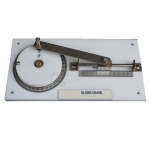
Torsional Vibrational Apparatus

Product Code : EL-AMLE-10638
Torsional Vibrational Apparatus (code EL-AMLE-10638) is a bench top unit used to study torsion, torsional stiffness and torsional vibration, including resonance and phase change. A corrosion-resistant steel torsion bar, 1300 mm long and 6 mm in diameter, is held in movable chuck pillars on a profiled aluminium base and can carry up to 3 mass discs of 150 mm and 228 mm diameter, excited by a speed-controlled exciter with oscillation sensors at each pillar.
Get a quote: use the Add To Cart enquiry button below, or send your quantity and delivery location through the contact page.
Specifications
| Parameter | Detail |
|---|---|
| Use | Investigating torsion, torsional vibration and torsional stiffness; observation of resonance and phase change |
| Base | Profiled aluminium with levelling feet at each corner |
| Chuck pillars | 4 vertical, movable pillars, each with a central shaft in precision bearings; bearing units positioned as required |
| Chucks | Grip the torsion specimen and carry a disc of varying mass and inertia |
| Masses on specimen | Up to 3 |
| Torsion bar | Steel, corrosion-resistant, 1300 mm long, 6 mm dia. |
| Mass discs | 150 mm and 228 mm dia. |
| Fixed end | Fifth chuck rigidly clamps the end of the specimen |
| Exciter | Speed controlled electronically from the main control unit, with drive crank |
| Control unit | Electronic exciter control with digital display |
| Sensors | Oscillation sensors integral with each mass pillar, recording angular movement and vibration amplitude |
| Signal output | Conditioned signals available to an oscilloscope (not supplied) for vibration analysis |
| Torsion arrangement | Manual torsion arrangement supplied, for modulus of rigidity experiments |
| Product code | EL-AMLE-10638 |
| Manufacturer | Engineering Lab Equipment, Ambala, Haryana, India |
What Is the Torsional Vibrational Apparatus Used For?
A shaft carrying rotating masses has natural frequencies of torsional vibration, and if it is driven near one of them the twisting builds up into resonance, a concern in engine crankshafts and drive lines. The student clamps the torsion bar in the chucks, fits one, two or three mass discs, uses the fifth chuck if a fixed end is wanted, and runs the exciter through a range of speeds from the control unit. The oscillation sensor signals, viewed on an oscilloscope, show amplitude rising to resonance and the change of phase, while the manual torsion arrangement is used to find the modulus of rigidity.
What to Specify When Ordering
- Quantity — the number of torsional vibration units required.
Frequently Asked Questions
What can be studied on the Torsional Vibrational Apparatus?
It is used to investigate torsional vibration and torsional stiffness, to observe resonance and phase change, and, with the manual torsion arrangement, to carry out modulus of rigidity experiments.
What are the torsion bar and mass disc sizes?
The corrosion-resistant steel torsion bar is 1300 mm long and 6 mm in diameter, and the torsional mass discs are 150 mm and 228 mm in diameter.
How many masses can be fitted?
With the four movable chuck pillars, a torsion specimen can be assembled with up to 3 masses, and a fifth chuck can clamp one end rigidly to give a fixed end.
How is the vibration excited and controlled?
An exciter with a drive crank transmits vibration into the specimen, and its speed is controlled electronically from the main control unit, which has a digital display.
Is an oscilloscope included?
No. The control unit conditions the signals from the oscillation sensors and makes them available to an oscilloscope, which is not supplied, for vibration analysis.
How are the chuck pillars arranged?
The four vertical chuck pillars stand on a profiled aluminium base with levelling feet; each has a central shaft running in precision bearings, and the bearing units can be positioned as required.
OEM Manufacturer
The Torsional Vibrational Apparatus is made by Engineering Lab Equipment (Engineering Labs Equipment Pvt Ltd) at its works at Plot No. 43, Industrial Park, Sector 2, Growth Center, Saha, District Ambala, Haryana, India. The company designs, makes and tests applied mechanics apparatus for statics, friction, machines and mechanisms for engineering colleges, polytechnics, technical training institutes and research laboratories in India and overseas, and can build equipment to an institution's own requirements. Tender and OEM enquiries are handled through the Tenders/OEM page.
Related Applied Mechanics Equipment
- Bifilar And Trifilar Apparatus — wall-mounted two-thread and three-thread pendulum for oscillation and moment of inertia experiments.
- Compound Pendulum — metallic rod pendulum with fitted metallic balls, pivoted at any point for period and frequency studies.
- Rotational Moment of Inertia Apparatus — three-string pendulum with photoelectric timing for moment of inertia and parallel axis theorem experiments.
See the full Applied Mechanics Lab Equipment range or all Mechanical Engineering Lab Equipment.
Request a Quote
For this and other applied mechanics lab equipment, schools and colleges can contact Engineering Lab Equipment, a manufacturer, supplier and exporter based in Ambala, India. To ask for a quotation, send the number of torsional vibration units required and your delivery location through the contact page, or use the Add To Cart enquiry button on this page.
Last updated: October 2026